What it takes to be an AI Leader
Artificial intelligence has transitioned from a future goal to a critical necessity for businesses. Successful leaders share a natural curiosity and a dynamic growth mindset, viewing AI as a holistic transformation applied across diverse areas.


Market Signals, Leadership Behaviors, and What Comes Next
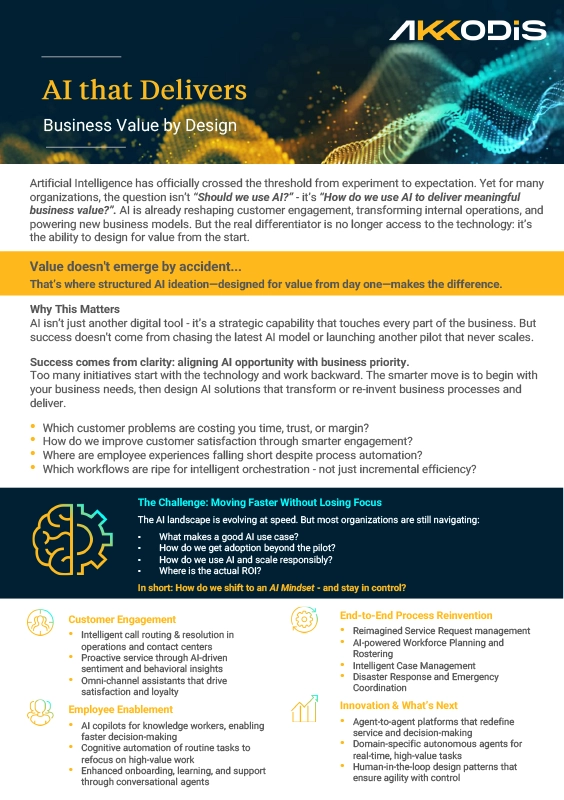
AI success goes beyond technology, it demands visionary leadership, organizational readiness, and the seamless integration of AI into people, processes, and governance.
30%
of generative AI pilots succeed1
1Gartner
26%
of AI project deliver value2
2Boston Consulting Group (BCG)
Lead with Intelligence: Your AI Advantage Starts Here
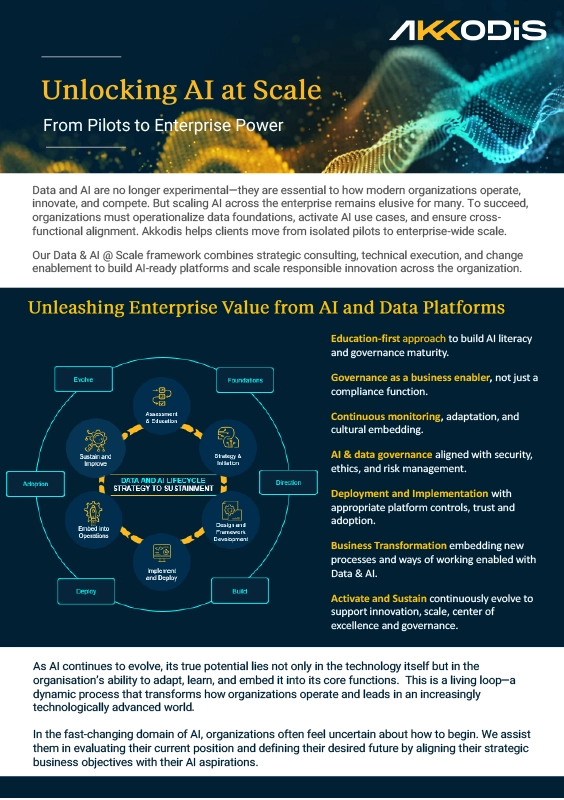
Akkodis delivers end-to-end intelligent automation and AI solutions to optimize processes, boost productivity, and drive innovation. Our roadmap approach enables organizations to move beyond pilots and embed AI empowering employees. By aligning strategy with execution and building capability over time, we support a scalable, ethical, and sustained AI journey from foundational literacy to advanced automation and innovation.

From Readiness to Real Impact
Don’t stay at the stage of Proof-of-Concept! Akkodis helps organizations to bring the promises of AI to scale deliver meaningful impact.
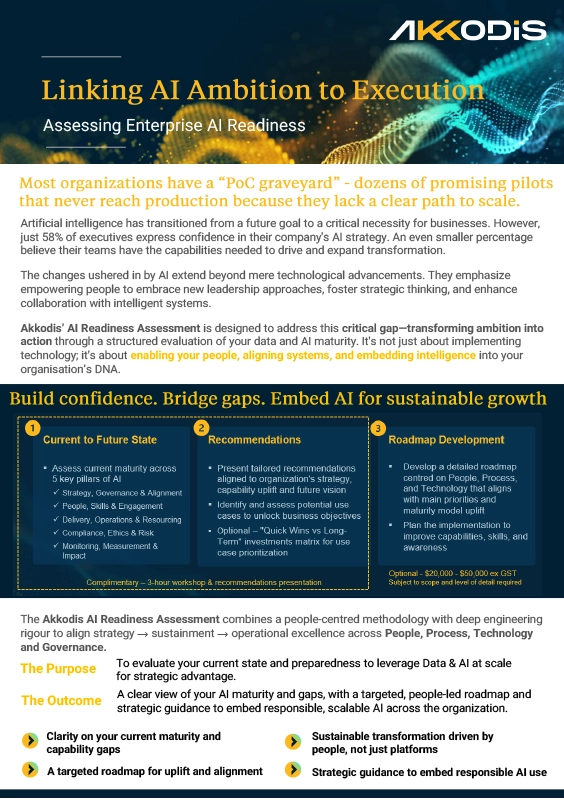
Akkodis’ AI Readiness Assessment is designed to address this critical gap, transforming ambition into action through a structured evaluation of your data and AI maturity. It's not just about implementing technology; it's about enabling your people, aligning systems, and embedding intelligence into your organization’s DNA.

Strong AI Practices
Akkodis delivers AI and data analytics solutions that turn complex data into actionable intelligence, helping you boost productivity, accelerate decisions, and drive innovation at scale. Powered by advanced AI agents and 2,000+ experts, we enable smarter operations, cost efficiency, and future‑ready performance across your enterprise.

The Akkodis AI Transformation Framework

Technology & Data Infrastructure
People Development, Training & Enablement
Cultural Adoption & Change Management
AI Strategic Alignment
AI Governance, Risk & Compliance
Akkodis AI Academy
The Akkodis AI Academy accelerates enterprise transformation by equipping your workforce with practical, real‑world AI skills. Developed by AI experts and powered by deep Microsoft partnerships, our programs build confidence, capability, and readiness across all levels.
- Structured pathways to accelerate enterprise AI transformation - Upskill Every Level of Your Organization- Industry‑recognized certifications, including Microsoft AI credentials - Microsoft‑Powered AI Upskilling Programs - Empower Teams to Operationalize AI at Scale- Executive‑level sessions for strategic AI leadership


“The question isn’t just how AI can generate content, but how it can ‘act’ reliably, transparently, and at scale - to deliver real business value.”
Global Head of AI, Data, and Analytics at Akkodis
Joshua Morley
Why Partner with Akkodis for AI?
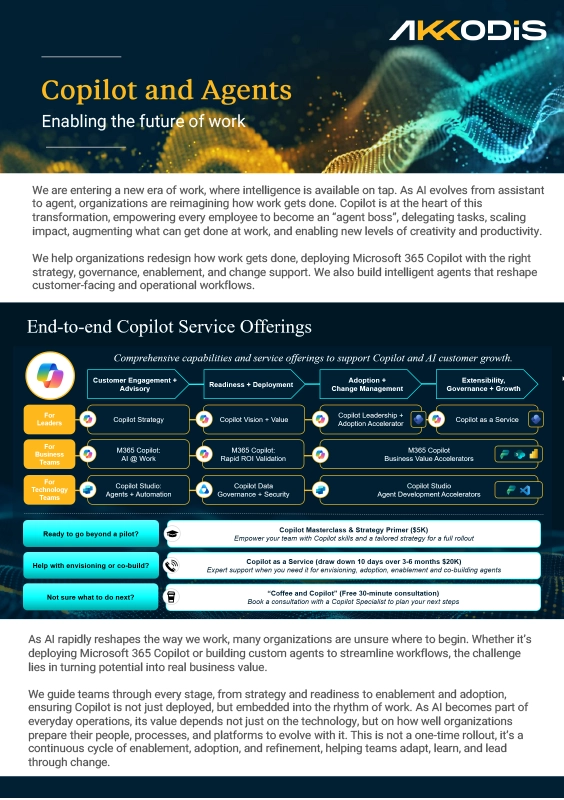
Akkodis helps organizations turn AI into real business value, fast, safely, and at scale. With deep engineering expertise, advanced data and AI capabilities, and enterprise‑wide skilling programs developed with Microsoft, we empower your teams to adopt AI confidently and operationalize it across everyday workflows. From strategic leadership enablement to hands‑on technical training, we ensure your people, processes, and platforms are ready to thrive in the intelligent era.

What comes next
AI success goes beyond technology. It demands visionary leadership, organizational readiness, and the seamless integration of AI into people, processes, and governance. Discover how to move beyond pilots and lead AI initiatives that deliver lasting value, reliably, transparently, and at scale. This eBook draws on global research, market insights, and real-world case studies to reveal how AI leaders are breaking through
Download Now
To go beyond
Frequently Asked Questions About Artificial Intelligence
Organizations use AI to increase efficiency, accelerate innovation, improve productivity, and unlock insights from growing volumes of data. As AI capabilities continue to evolve, enterprise AI is becoming a strategic driver of digital transformation across industries.
Beyond efficiency gains, AI creates opportunities for innovation, improved customer experiences, enhanced employee productivity, and new business models. Organizations that successfully adopt AI are increasingly positioned to compete more effectively in data-driven markets.
Machine Learning, which identifies patterns and generates predictions from data.
Generative AI, which creates content, synthesizes information, and supports conversational experiences.
Natural Language Processing (NLP), which enables systems to understand and interact using human language.
Computer Vision, which analyzes images and video data.
Predictive Analytics, which forecasts outcomes and supports decision-making.
These technologies are often combined to solve complex business challenges and support intelligent, data-driven operations.
Unlike traditional automation technologies, generative AI can interact with users through natural language and adapt to a wide variety of business scenarios. As a result, organizations are using it to improve employee experiences, accelerate innovation, and unlock new levels of productivity.
To realize these benefits safely, enterprises must combine generative AI capabilities with governance, security, and operational controls.
Responsible AI includes considerations such as fairness, privacy, cybersecurity, risk management, explainability, and human oversight. A strong responsible AI strategy helps organizations build trust and reduce operational and regulatory risks associated with AI adoption.
Many AI initiatives also struggle because they focus on technology without addressing people, processes, and operating models. Successful AI adoption requires a balanced approach that aligns business strategy, data, technology, governance, and workforce readiness.
- Increased operational efficiency
- Improved workforce productivity
- Faster decision-making
- Enhanced customer experiences
- Reduced operational costs
- Better forecasting and planning
- Accelerated innovation
- Improved risk management
Across these industries, AI is being used to improve operational performance, optimize supply chains, support predictive maintenance, enhance customer experiences, strengthen decision-making, and accelerate innovation while maintaining compliance and governance requirements.
The most successful organizations treat AI as both a technological and organizational capability, integrating it into business operations, workforce practices, and strategic planning.
Supported by more than 2,000 AI and data specialists worldwide, Akkodis delivers AI solutions across complex and highly regulated industries. Through deep expertise in engineering, digital technologies, and business transformation, Akkodis helps organizations convert AI ambition into measurable business outcomes.