What If Your Next Release Tested Itself Overnight?
Automating mobile app regression to replace manual QA with overnight, evidence-backed releases.
4 minutes
21st of July, 2026
Automating Mobile App Regression
Manual regression is a hidden tax on every mobile release. It costs the better part of a day of skilled QA time, and it only catches bugs at the worst possible moment, right before launch. Automation flips both problems at once. Here is how our engineers turned that recurring tax into an overnight, self-grading process that signs off each build with evidence instead of opinion, at zero licensing cost.
The Hidden Cost of Manual Regression
Manual regression looks cheap because the cost is hidden in plain sight. It is spread across a day of skilled QA effort, repeated on every release candidate, and re-spent in full every time a fix needs a retest. Multiply that by a year of releases and the number stops looking like a line item and starts looking like a strategy problem. Worse, because the sweep only happens at the end, the bugs it misses are the most expensive kind to fix, the ones your customers find first.
The industry has measured this for decades, a defect caught in production costs many times more to fix than the same defect caught early (National Institute of Standards and Technology [NIST], 2002; Boehm, 1981), and the Capgemini World Quality Report (2024) finds that test automation can cut testing effort by up to 60 percent.
Driving the Real App, Not a Mock
The suite we built does not test a simulation of the app. It drives the actual application on a device, the way a person does. It taps, types, scrolls, and verifies what genuinely appears on screen, walking the same journeys a tester would walk by hand.
Coverage spans more than 90 automated customer journeys across the app's core areas:
- Login and search
- Product pages and cart
- Addresses, orders, and loyalty rewards
The app itself is demanding to test: cross-platform, built in Flutter, and fully bilingual in English and Arabic with right-to-left support.
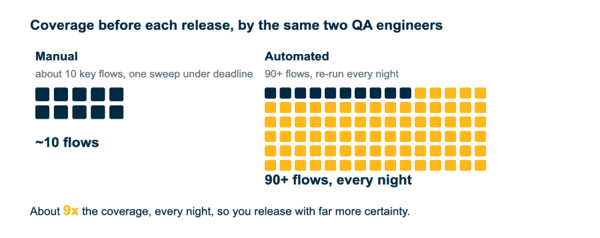
Most important is what comes out at the end. After each run, the suite grades itself. It produces a single-page report with a clear GO or NO-GO release verdict, computed from defined quality gates and never written by hand, backed by a full gallery of screenshots and a screen recording as evidence. When something fails, the team sees exactly what the app showed at that moment. Shipping, or holding, becomes auditable, repeatable, and defensible.
The Outcome: Time Reclaimed, Quality Climbed
The change showed up in two places at once.
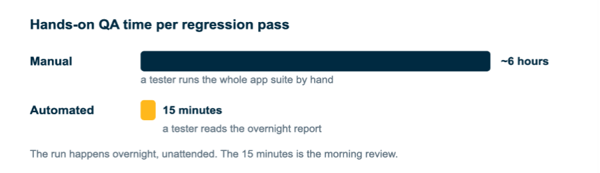
Time first: a regression pass that used to consume the better part of a QA day now runs overnight on hardware we already owned, leaving the team a 15-minute read in the morning.
Quality second: in a single improvement cycle the share of journeys passing climbed by more than 20 points, and the release verdict flipped from NO-GO to GO.
The suite has already earned its place by catching real defects, including a hidden pop-up that was silently blocking the app, a broken login input, and accessibility gaps, each surfaced from the evidence rather than guesswork. There was a useful side effect, too. The accessibility identifiers the tests rely on are the same ones screen readers use, so hardening the app for automation also made it more accessible for real users.
Built on Open Source, at Zero Licensing Cost
None of this required a new budget to start. The suite is built on a mature open-source mobile testing engine, with no licensing fee, running on hardware the team already owns. The return does not depend on procurement, vendor lock-in, or per-seat pricing.
The investment is engineering effort to design the right journeys and gates, and the payoff compounds on every release that follows.
Where It Goes Next
A regression suite is most valuable when it runs without anyone remembering to start it. The roadmap moves toward continuous delivery (Humble & Farley, 2010):
|
🌙 Runs itself every night No one has to remember to start it. Every build is checked by morning. |
⚡ Checks before every merge A fast smoke test catches issues before they ever reach a release. |
|
📱 iOS and Android, one suite The same tests cover both platforms, with no rewrite. |
🌐 English and Arabic Automated right-to-left checks, so a layout break in either language never ships. |
The Bottom Line
Manual regression feels safe because it is familiar, but it quietly taxes every release in time, in risk, and in confidence. Automated end-to-end testing converts that recurring cost into a durable asset, auditable, repeatable, and defensible.
So here is the real question before your next release: how much longer will you pay the hidden tax of manual regression?
In a matter of weeks, you can move from opinion-based releases to evidence-backed decisions, without adding licensing cost or slowing your team down.
If you want to see what this looks like in your environment, let's run a proof of concept on your app and show you the results overnight.