A Skills-Development Strategy to Accelerate the Real-World Deployment of IOWN®
7 minutes
20th of May, 2025
The IOWN® concept *1 uses revolutionary light-based technologies to move beyond the limits of today’s infrastructure and bring about a dramatic leap forward for the internet. A shortage of engineers to drive its real-world deployment has become a real challenge. How should companies develop the talent needed to bring this new technology to life? Tatsuya Yamashita of NTT Communications and Naoya Wada of Akkodis discussed it together.
How the Engineer’s World has Changed
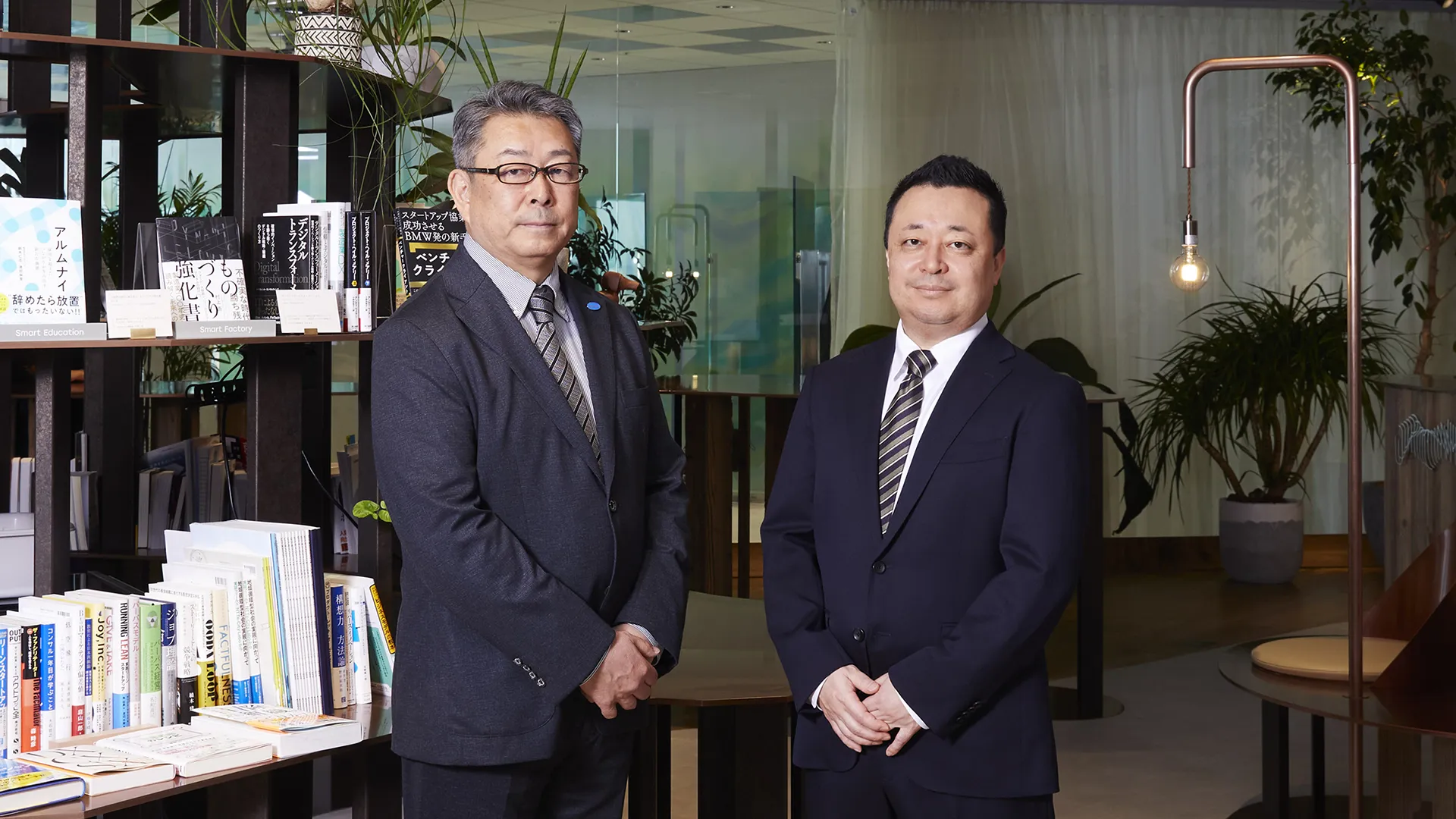
Yamashita I joined NTT in 1988. The first work I was assigned to was building communication systems that connected digital telephone lines to UNIX-based workstations. Starting out that way, I naturally grew interested in the internet. Before long, there was talk of building an internet environment inside the company too, and as the first signs emerged that the internet would spread to general businesses as well, a department dedicated to the internet was launched, probably the first of its kind among NTT Group’s business divisions. But in those days, there weren’t yet many engineers who knew the internet well. I myself was still very much a work in progress as an engineer, and since no one person could do it all, we moved forward through trial and error, working together to train up the young people assigned to us as internet engineers. Back then, there was no real difference between a server and a router. Starting from building our own cables, and of course including the UNIX file system, we designed, built, and operated internet systems only after understanding everything: transmission systems (Ethernet), routing (IP routing), name resolution (the domain name system), and the mechanisms for delivering applications (mail systems), functions that today are divided up among routers, servers, and appliances. Back then, it was simply taken for granted that an engineer would be full-stack.

Wada That was an era when one person did everything. But in step with broader trends, engineers’ work has become steadily more specialized, and the division of roles has advanced a great deal.
Yamashita Especially over roughly the past ten years, more and more of our new graduate hires are interested in AI, data analysis, and the cloud, while very few take an interest in networks or the internet. I sense a general feeling that it’s enough to be able to make good use of the virtual networking and other functions that cloud platforms such as AWS (Amazon Web Services), Azure (Microsoft Azure), and GCP (Google Cloud Platform) provide, without needing to understand networks in any depth.
Wada It’s true, the physical side of things has gradually receded over time. We’ve now entered an era where infrastructure itself is realized through software. It really is a convenient age, where you can do all kinds of things without fully understanding the infrastructure that underlies it all.
Developing the Infrastructure Engineers of Tomorrow

Yamashita Let me share something here that has a real impact on Japan’s ICT industry. In Japan, under the leadership of the Ministry of Economy, Trade and Industry, the Strategic Energy Plan is reviewed once every three years, and this year, 2025, happens to be the year the 7th Strategic Energy Plan is being drawn up. It forecasts an explosive increase in data volumes, driven by the construction and expansion of data centers and semiconductor plants. An increase in the volume of data in circulation means a correspondingly massive increase in the electricity consumed to process it.
Wada There are forecasts that electricity demand will increase explosively, driven in particular by the spread of generative AI. Along with that, I think there’s a risk that the amount of CO2 emitted in generating that power will increase as well.
Yamashita For example, one estimate holds that if physically transporting something takes 10,000 units of energy, transporting it as electricity cuts that to one-hundredth, and transporting it as data over communications networks cuts it to one ten-thousandth. Right now, data centers are concentrated in major metropolitan areas such as Osaka and Tokyo, but if we located data centers near power plants instead, Japan as a whole could cut, at minimum, the power consumption tied to the data traffic that data centers generate by a factor of 100.
Wada The closer the distance between the power plant and the data center, the more that brings down the cost of transmitting the electricity.
Yamashita Exactly right. This idea of building electric-power infrastructure and communications infrastructure as one integrated whole is called the “Watt-Bit” concept. In other words, the importance of rebuilding both communications and power-transmission infrastructure is rising again. Meanwhile, the Ministry of Internal Affairs and Communications, which oversees communications infrastructure, has positioned an all-optical network as one of the three priority technology areas of Beyond 5G, which is targeted for realization in the 2030s, and Japan’s major telecom carriers are all pushing ahead with building out all-optical networks. KDDI calls theirs the All Photonic Network, SoftBank calls theirs the All Optical Network, and NTT, within the IOWN concept, calls it the All-Photonics Network.
Wada That’s a sign that the importance of infrastructure in its original sense is rising again. We’re now in an age where you can build virtual infrastructure without ever touching a piece of equipment, but I think we need to return to first principles once more, including understanding the physical optical network itself.
Yamashita That’s true. That said, it would be difficult, in terms of both specialization and motivation, to have every one of our engineers study starting from optical cables, so I’d be happy if even one in ten of them took an interest. That’s exactly why I'd really like them to take the IOWN Concept Basic Training from Akkodis.
Wada Thank you. Our infrastructure engineer training program is structured to include a physical understanding of the subject as well. It covers everything from a basic understanding of infrastructure through to the fundamental concepts of IOWN.
Yamashita The keywords we use in talking about the IOWN concept include not just the all-optical network, but also a new approach we call “Disaggregated Computing,” which applies photonics-electronics convergence technology. This moves away from the conventional, server-oriented idea of networking together computers that are closed up in individual boxes, and instead connects resources such as CPUs and memory directly by light, pooling them at the scale of a rack or a data center, so that whatever resources are needed can be freely connected as needed. By connecting these resources to one another with light, we avoid wasting electricity. To make this a reality, we’re going to need a great many engineers who can build starting from the infrastructure itself. What’s more, it would be ideal if those same people were also strong in security, data analysis, and AI. It would be great to see more people who could be called full-stack engineers in that sense.
Wada Everyone recognizes that this kind of talent development is necessary, and yet it hasn’t progressed nearly that far. Why do you think that is?
Yamashita For an engineer who studied hard for entrance exams, completed their studies at university, and joined the company hoping to work with AI, I think many of them would feel a real sense of disconnect if you told them, “From now on, please study infrastructure too.” So my sense is that if people could take an interest in infrastructure back in their student days, talent development would go much more smoothly.
Wada So educating students is important too.
Yamashita Trying to redirect people toward a different path after they’ve already joined the company takes a great deal of time and effort, and it’s hard to keep their motivation up. So I think it would be good if high schools and universities could build in curricula that develop full-stack engineers who also understand networking. That was the thinking behind founding the Advanced IT Architect Human Resource Development Council (AITAC) eight years ago. Several domestic IT companies, including NTT Communications, collaborate through it to jointly support the development of the infrastructure engineers who will underpin the coming era. Using the curriculum built there, we have taught classes at the University of Tokyo, Keio University, Kyushu University, and other institutions.
Wada Certainly, this needs to be thought about over a much longer time span. But to actually carry it out, there’s a shortage of teachers and instructors capable of teaching it.
Yamashita It may not be something we can solve overnight. Suppose IOWN takes root as social infrastructure, in Japan and around the world. The number of people living their lives on top of that foundation will grow. If we can create a world where the word and the image of IOWN feel familiar and close to ordinary people, then children who grow up wanting to “get involved with IOWN” or “become an IOWN engineer” should naturally follow. Given that, I think we really do need to put effort into building awareness of IOWN and spreading it further.
Wada I do think the approach of providing content to universities and teaching students that way is necessary. But if IOWN could feel familiar from an even earlier age, from childhood, I think the number of people who naturally want to become an IOWN engineer would grow on its own. When the internet first appeared, there was a sudden surge of people who vaguely felt they wanted to work in something connected to the internet. I imagine something similar could happen with IOWN as well.
Yamashita You just brought up the internet as an example. When people hear the word “internet,” I doubt very many of them picture fiber-optic cables or routers. I suspect most people instead picture the applications you use on the internet, or browsers such as Google Chrome or Edge. Someone who thinks of those as the entry point to the internet is, if anything, already among the more informed. Taking it further, there may well be many people who aren’t even conscious of the difference between a mobile phone and the internet.
Wada Being able to talk on a mobile phone and being connected to the internet might well feel like the same thing to them.
Yamashita We’re advancing research and development on IOWN with an eye toward practical implementation in 2030. Eventually, as IOWN spreads, starting with the all-optical network, we’ll reach an era when cars that can avoid accidents through autonomous driving are simply an everyday sight on the road. IOWN will be contributing behind the scenes, but I suspect end users will end up using it without ever being conscious of it.
Wada If something more physical and intuitively easy to grasp comes along, it seems like IOWN could spread all at once.
Building the IOWN Concept Basic Training Program
Wada This time, we refined the IOWN Concept Basic Training under Yamashita ’s supervision.
Yamashita IOWN Concept Basic Training 1.0 was already complete, so they showed me a draft of 2.0. In it, I found wording that read something like “IOWN’s APN is…” But as I mentioned earlier, different companies use different names for the all-optical network, and NTT, within the IOWN concept, calls its version the All-Photonics Network. So I pointed out that it would be easier for learners to follow if the training first explained what an all-optical network is, and only then moved on to explain that, for example, the APN within the IOWN concept advocated by NTT is such-and-such. Checking details like that, I gave advice throughout the whole program, simply to make sure it was easy to understand and left no room for misunderstanding.
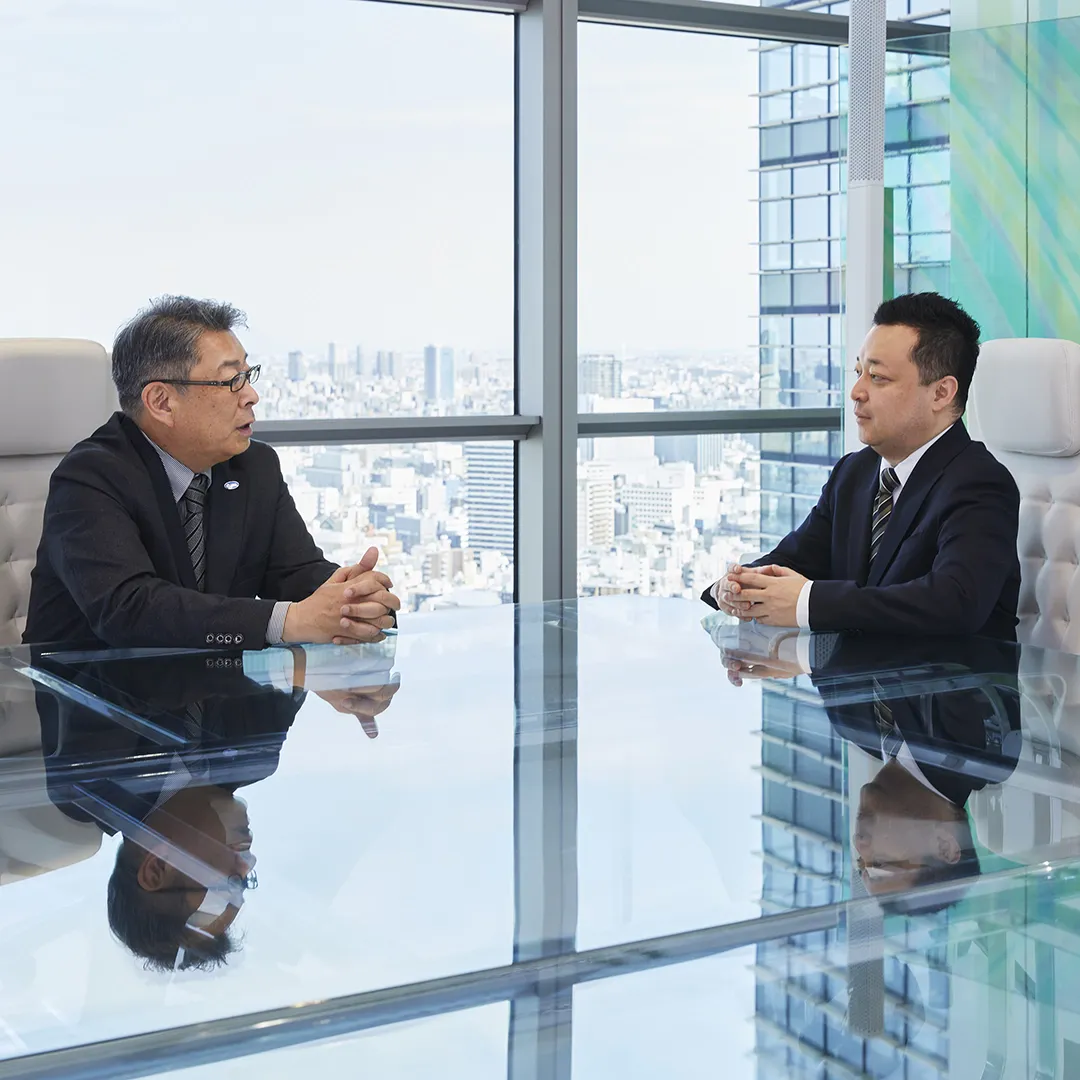
Wada We reflected Yamashita’s input and updated the content so that it would draw the interest of a wider range of people. The original reason we set out to create this training in the first place was that awareness of IOWN itself was overwhelmingly low. Even within the NTT Group, there weren’t many people who could explain it properly, and it hadn’t spread nearly that far. So we wanted not just engineers but a wide range of people to get to know it. With that in mind, we went back to infrastructure engineers as the starting point once again, and built a story around how that connects into talent development. Of course, developing engineers who can also handle every application and service that runs on top of that infrastructure is a considerably difficult undertaking. But in terms of building correct understanding, I think there’s enormous value in increasing the number of engineers who understand the subject broadly, even if any one person’s understanding of it is not especially deep.
Yamashita I think we need both kinds of talent. To develop engineers who understand the full stack, what we call "advanced IT architects," I'd want the instructors who teach them to be full-stack engineers themselves, first and foremost. That said, it’s not as though everyone who takes the university course needs to become a full-stack engineer. Even studying it a little lets people gain a broad, if shallow, understanding. From the world’s point of view, that kind of person can already be considered someone who knows the subject well. And then, as people go on into master’s and doctoral programs, the image I have is of them growing into the seeds of future advanced IT architects.
Wada That’s right. At the moment, both kinds of talent are in short supply, so I think we first need to broaden the base by increasing the number of people who have learned broadly, if shallowly. Without that base, full-stack talent won’t emerge either.
Yamashita The first priority is simply to increase the number of people in society who have taken your training and understood the outline of it. Within that group, it would be wonderful if one or two of those who trained went on to earn a doctorate, or if the people who performed well were guided toward hands-on training. That kind of positive spiral is what I'd love to see emerge. If, after taking the training, even a few more people come away thinking “the world will change if the IOWN concept is realized,” that alone would already count as a great success.
Wada That’s exactly what we’re aiming for.
Why Transformation Must Cross Job Boundaries
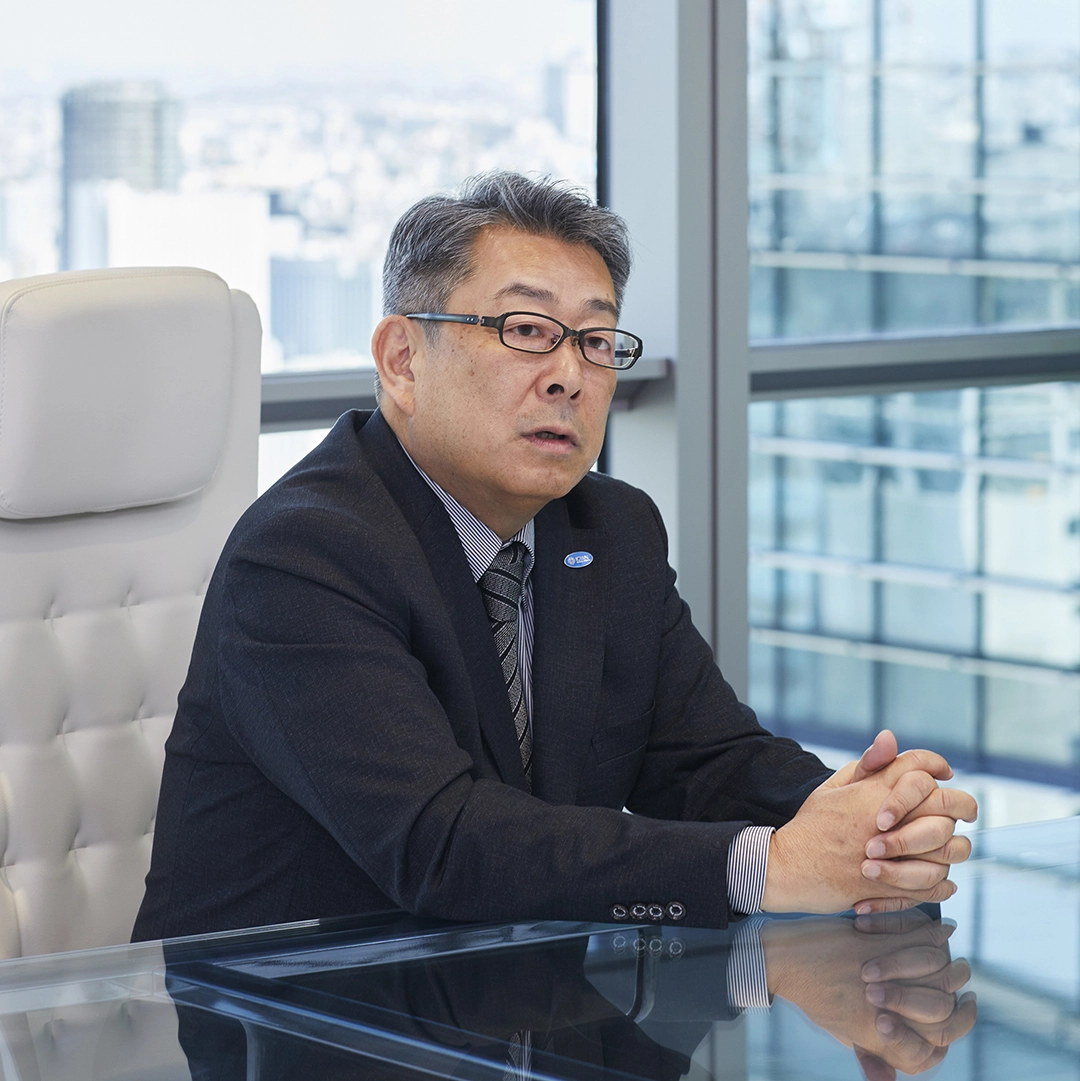
Wada I fully understand the need to increase the number of engineers. On top of that, when it comes to spreading IOWN out into the world, I think we also need a perspective on how to grow it as a business. From that angle, do we think in terms of business people who understand IOWN, or engineers who understand IOWN? Looking at the proportions, engineers who also have a business perspective are still rare in the market. How should we think about this talent gap?
Yamashita That’s an extremely difficult question. In any industry, I feel that the people who are genuinely good at their jobs are often people who, even without being all that knowledgeable about the technology themselves, are skilled at connecting with people who are deeply versed in it. What’s more, I think programmers who write simple code will no longer be needed going forward. That’s because we’ve entered an era where you can instruct a generative AI and have it write accurate, bug-free code. As that trend keeps advancing, the work that ultimately has to be done by humans may end up being only the work of the architect who designs the system as a whole. Those people occupy a position close to that of a consultant, so I imagine they turn out, as a result, to also be capable business people. In other words, I think the people who are truly capable in business are the ones who have the qualities of both an architect and a generalist. So that kind of talent may well be the next career path an architect should aim for.
Wada I see. That makes sense.
Yamashita Overseas, it’s not unusual at all to find people who study law while also earning a doctorate in mathematics. For them, there’s no such thing as being boxed into “science” or “humanities.”
Wada Overseas, the sciences and humanities are fused together. They were never really divided into “humanities” and “sciences” to begin with. Japan has long tended to want to separate people into humanities and sciences, but I feel that what today’s era calls for isn’t a specific field like liberal arts, but rather learning broadly and cultivating the ability to look at things from multiple angles.
Yamashita In this new era, I think engineers and sales people alike would do well to abandon that kind of fixed thinking, and my sense is that the split between people who can use the latest technology, including AI, wisely and those who can’t is only going to grow sharper. Someone who can make full use of generative AI can surely handle sales to some degree as well, and has the makings of both a full-stack engineer and an architect. In an age where generative AI has become the norm, and of course IOWN has become the norm too, I think we need to do away with the fixed categories of science versus humanities, and sales versus technology.
Wada That’s right. Those categories are going to disappear.
Yamashita So it would be a good thing if, after studying your company’s IOWN Concept Basic Training, some people came away wanting to use it in sales, in whatever industry they happen to be interested in. Some will no doubt take it in the direction of digging deeper into the technology. And it would be just as fine to see a salesperson emerge who says, “I don’t fully understand it, but it’s such an exciting story that proposing it to that field could be really interesting.” After all, this basic training is meant to be the entry point.
The Future the IOWN Concept will Bring
Wada In that sense, IOWN could well become one of the sparks that changes Japan going forward.
Yamashita That said, this is ultimately NTT’s own concept, and it could well be called something of a pipe dream. But without a dream, no concept is ever born in the first place. Even if, ten years from now, people were to say “well, that didn’t work out after all,” I still believe that proposing the IOWN concept was not a waste, and that its direction was not mistaken. A concept is something that gets carried forward, generation after generation. When this concept is truly implemented in society, I hope we’ll be able to picture a future in which someone in Japan says, “I won a Nobel Prize thanks to IOWN,” or a Japanese company says, “This is how we grew our business.”

Wada That would certainly be welcome news for us as Japanese people.
Yamashita To put it simply, I think of Ichiro or Shohei Ohtani as symbols of what makes people see the Japanese as remarkable. When Japanese people excel, Japan itself gains energy. I think that is precisely the kind of international competitiveness Japan is most respected for. So I feel that if this IOWN concept is realized, and Japanese people become internationally famous as its central members, or receive outstanding honors for it, that would be of real, genuine benefit to Japan.
Wada Being recognized by the world is certainly the clearest measure of it. I think it would be enormously impactful if, through IOWN, we could develop talent capable of succeeding globally, not just in Japan.
Yamashita And it would be best of all if that person could then say, “Actually, I took the Akkodis training.”
Wada That would be the ideal outcome. Going forward, we’d like to be in a position to propose Akkodis services and talent in all kinds of situations, not just training. We look forward to continuing to work with you. Thank you very much for today.
Yamashita Thank you, the pleasure was mine.
Akkodis and the IOWN Concept
Joining IOWN Global Forum™*2
Working toward the realization of the next-generation communications platform, the IOWN concept.
Akkodis became the first company specializing in talent creation and development to join IOWN Global Forum as a Sponsor Member, working toward the realization of the IOWN concept. We provide the know-how and expertise we have built up through talent development across a wide range of engineering fields. In doing so, we help advance the creation of use cases that look ahead to both technology R&D and real-world deployment, contributing to the early practical application of the IOWN concept and the spread of its services.
New Organization: The IOWN Promotion Office
To support the realization of the IOWN concept, Akkodis has established the IOWN Promotion Office to develop talent that drives technological innovation and to create new employment opportunities.
- Developing engineers who drive technological innovation
- Creating new employment opportunities
- Strengthening collaboration across different industries
- Global expansion
Producing “IOWN Concept Basic Training 2.0”
Akkodis produces content designed to help learners acquire a foundational understanding of IOWN.
Getting to know IOWN
Training Curriculum
- Power depletion
- Communication quality
- APN [All-Photonics Network]
- Photonics-Electronics Convergence
- DCI [Data-Centric Infrastructure]
- Smart stadiums
- Promoting telemedicine
Notes
*1 IOWN® (hereinafter "IOWN") is an abbreviation of Innovative Optical and Wireless Network, and is a trademark or registered trademark of NTT, Inc. For more information about IOWN, please visit https://www.rd.ntt/iown/.
*2 IOWN Global Forum™ (hereinafter "IOWN Global Forum") is a trademark of the IOWN Global Forum, Inc. For more information about IOWN Global Forum™, please visit https://iowngf.org/. Akkodis Consulting Ltd. is a Sponsor Member of IOWN Global Forum™, which promotes IOWN®.