Physical AI Explained: How It Works and Why It Matters
What is physical AI, and how does it reshape robotics, AVs, and smart spaces? Explore the technology, key use cases, and how to get started.
4 minutes
15th of July, 2026
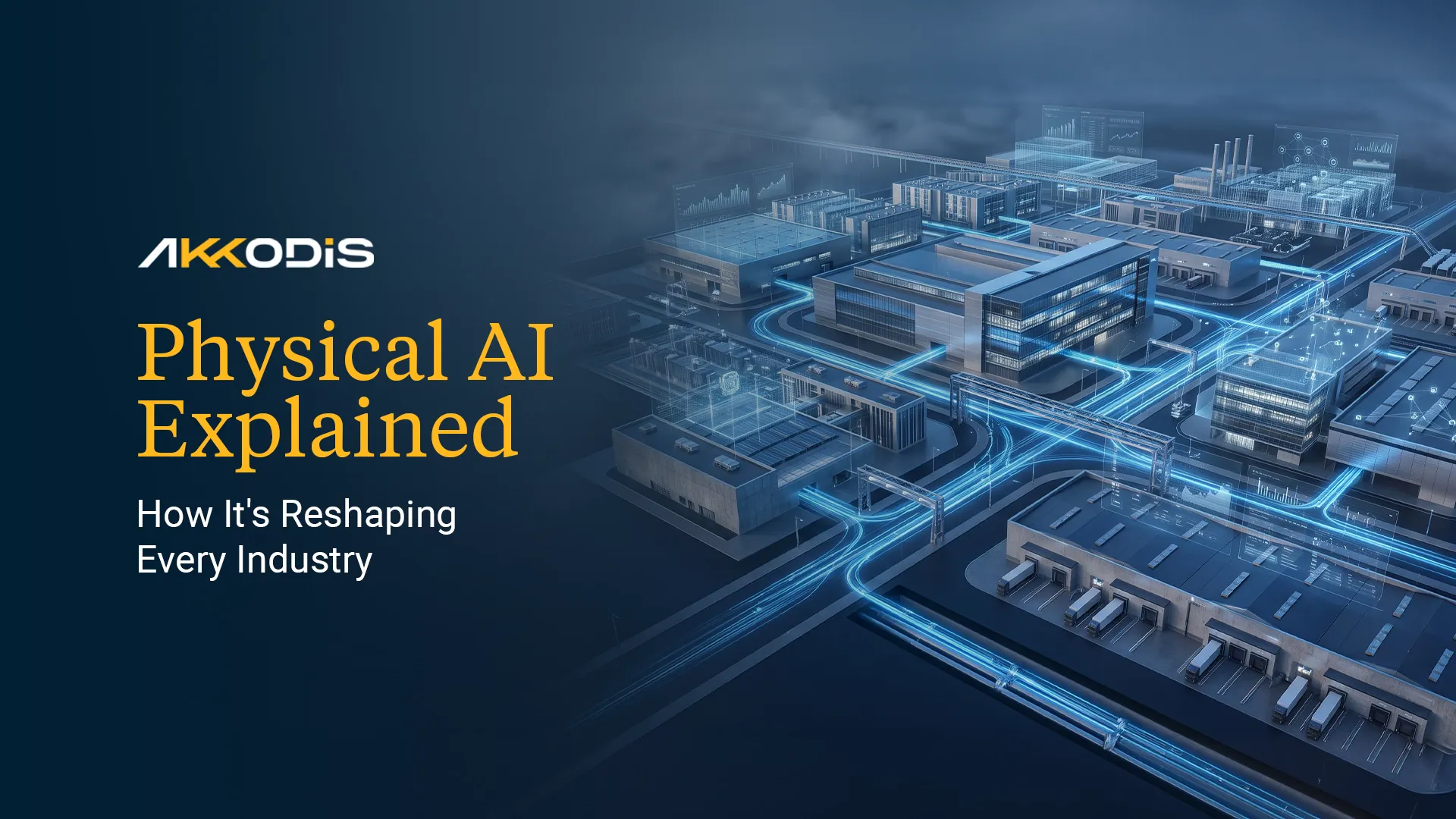
Physical AI enables autonomous systems (robots, vehicles, and smart infrastructure) to perceive, reason, and act in the physical world. By combining multimodal sensing, generative AI, and reinforcement learning, physical AI moves far beyond traditional automation. The global physical AI market was valued at approximately $5 billion in 2025 and is projected to reach $68 to $84 billion by 2034 to 2035.
Generative AI captured the world's attention when ChatGPT launched in 2022. Now, a new wave is building. One that takes AI out of the browser and into the physical world.
Physical AI takes AI out of the browser and into the real world. It allows machines to perceive, reason, and act autonomously in physical environments.
Georgetown's Center for Security and Emerging Technology has ranked physical AI alongside ImageNet (2012) and ChatGPT (2022) as a genuine technological inflection point. Deloitte reports that 80% of business leaders surveyed plan to adopt physical AI within two years. In January 2026, industry leaders declared it the "ChatGPT moment for physical AI" at CES.
The signal is clear. Physical AI is no longer a future concept. It's a present-day transformation.
This guide breaks down what physical AI is, how it works, and what it means for your organization.
Why Does Physical AI Matter?
Traditional automation was effective but rigid. Industrial robots excel at repetitive tasks in controlled environments. When reality deviates from their programming, failures occur.
Physical AI solves this. Rather than following fixed routines, physical AI systems learn to adapt. They perceive their environment through sensors, make autonomous decisions, and adjust behavior in real time.
The business case is already proven. Approximately 542,000 new industrial robots were installed worldwide in 2024, a record high. Robot unit costs have fallen 30x over the past decade. Waymo has completed over 10 million paid robotaxi rides. Amazon's millionth robot delivered a 10% improvement in fleet efficiency. Foxconn's AI-powered robots improved cycle times by 20 to 30%, reduced error rates by 25%, and cut operational costs by 15%.
Physical AI is transforming manufacturing. Its impact extends well beyond the factory floor.
Where Physical AI Is Creating Value
Robotics
Physical AI elevates robots from rigid automation to genuine autonomy. Real-world deployments already span warehousing, manufacturing, healthcare, and logistics.
- Autonomous Mobile Robots (AMRs) navigate complex warehouse environments and avoid obstacles using live sensor feedback.
- Robot arms adjust grasping strength and positioning based on object shape and position, handling both fine and gross motor tasks.
- Surgical robots learn intricate procedures, demonstrating the precision physical AI enables in high-stakes settings.
- Humanoid robots combine perception, reasoning, and motor skills for general-purpose tasks.
Mercedes-Benz is already piloting humanoid robots for material handling in its factories, freeing workers for higher-value roles.
Autonomous Vehicles
Physical AI enables autonomous vehicles to perceive and respond to their surroundings in real time, across open freeways, dense cities, and unpredictable weather. Vision-language-action (VLA) models fuse perception, planning, and control into a single architecture. Vehicles process live inputs and output precise actions, continuously adapting to conditions that no rule-based system could anticipate.
Smart Spaces
Factories, warehouses, and airports generate vast amounts of operational data. Physical AI converts this into intelligence. Computer vision models enable real-time tracking of people, vehicles, and equipment. AI agents automatically detect anomalies, flag safety risks, and deliver alerts before problems escalate. Honeywell is already running AI-assisted control rooms at major industrial sites, reporting faster incident response and improved operational reliability.
How Does Physical AI Work?
Generative AI models excel at language and reasoning. But they lack grounding in the physical world. They don't understand gravity, friction, or spatial relationships.
Physical AI closes this gap by combining advances in perception, reasoning, and control into a single decision-making system. It processes multimodal inputs, including video, images, speech, text, and live sensor data, and converts them into actions autonomous machines can execute.
The Role of Synthetic Data and Simulation
Training physical AI models requires large volumes of accurate real-world data. Collecting it at scale is slow, expensive, and often dangerous.
Digital twins solve this. A digital twin is a high-fidelity virtual replica of a real environment, such as a factory floor or logistics hub, where simulations can be run at scale. Systems are trained and validated in simulation before any real-world deployment.
World Foundation Models (WFMs) take this further. Trained on vast amounts of real-world video, WFMs learn the rules of the physical world and can generate realistic future scenarios. Companies including Google DeepMind, Microsoft, Meta, and OpenAI are actively developing WFMs that serve as immersive training environments for autonomous agents, dramatically accelerating development timelines and reducing real-world risk.
The Role of Reinforcement Learning
Reinforcement learning (RL) is how physical AI agents develop skills. An agent takes actions in a simulated environment, receives feedback, and iteratively improves. Repeated across millions of interactions, this process produces systems capable of complex physical tasks: navigating uneven terrain, manipulating unfamiliar objects, and adapting to conditions they have never encountered before.
For executives, the key point is this: simulation-driven RL dramatically compresses the time it takes to develop deployable autonomous systems, at a fraction of the cost and risk of real-world trials.
How Can Organizations Get Started?
The technology is ready. The critical question is how to implement it without falling into the trap of expensive, isolated pilots that never scale.
Start modular. Identify one or two well-defined use cases where the data is solid, the environment is controllable, and the outcomes are measurable. Deploy there first. Build institutional confidence. Then expand.
The Importance of OpenUSD
OpenUSD (Universal Scene Description) is the open standard underpinning physical AI and digital twin workflows across industries. It ensures that simulation assets (robots, environments, physical properties) can be built once and deployed across different platforms without costly reformatting. The Alliance for OpenUSD now spans robotics, automotive, aerospace, and defense. For any organization building physical AI at scale, OpenUSD interoperability is not optional. It is foundational.
The Physical AI Development Pipeline
A typical production pipeline flows through five stages:
- Data capture. Real-world environments are digitized and standardized.
- Digital twin construction. A physics-accurate virtual replica is built.
- Synthetic data generation. Simulated scenarios are run at scale, enriched by World Foundation Models.
- Model training. VLA models and RL agents are trained iteratively within the simulation.
- Validation and deployment. Models are tested in simulation, then deployed on real hardware with clear governance protocols.
This is not a one-time project. Real-world data feeds back into the simulation continuously, improving future training runs. Organizations that establish this feedback loop early move faster and scale more confidently.
Physical AI Is No Longer on the Horizon
The technology is here. Deployments are live. Cost curves are moving in one direction.
For leaders across engineering, manufacturing, logistics, and infrastructure, the question is no longer whether physical AI is relevant. It is how quickly your organization can build the capability to deploy it well.
Akkodis works with global organizations to turn physical AI ambition into measurable outcomes. From building digital twins to validating autonomous systems and deploying AI into production, we help organizations move from experimentation to real-world implementation. With 40,000 engineers and digital experts across more than 30 countries, we have the scale and cross-industry expertise to make it happen.
Organizations that begin building these capabilities today will be best positioned to compete tomorrow. Explore how Akkodis can accelerate your physical AI program.
Frequently Asked Questions
What is physical AI in simple terms?
Physical AI refers to AI systems that perceive, reason about, and act in the physical world. They combine sensors, AI models, and actuators to make autonomous decisions in real time. Examples include industrial robots, autonomous vehicles, and smart factory systems.
How is physical AI different from traditional robotics?
Traditional robots follow pre-programmed rules and fail when conditions change. Physical AI systems learn from data and adapt in real time, handling unfamiliar objects, recovering from errors, and navigating new environments without reprogramming.
What industries will physical AI impact most?
Physical AI is already reshaping manufacturing, logistics, automotive, healthcare, construction, and urban infrastructure. Any sector where autonomous machines and real-time decision-making drive operational value is a candidate for adoption.
What is the sim-to-real gap?
The sim-to-real gap is the difference between how a physical AI model performs in simulation versus the real world. Closing this gap (by building more physically accurate simulations) is one of the central engineering challenges in physical AI development.
What is Open USD and why does it matter?
OpenUSD is an open standard for describing and composing 3D environments. It enables simulation assets to be built once and used across different tools and platforms without data loss, making scalable physical AI development possible.
How does reinforcement learning train physical AI systems?
Reinforcement learning trains agents through simulated trial and error. The agent takes actions, receives feedback, and refines its behavior over millions of interactions, developing skills that transfer to real-world deployment.
How should organizations begin their physical AI journey?
Start with a well-defined use case where data is reliable and outcomes are measurable. Build or adopt a digital twin. Establish a simulation pipeline before purchasing hardware. Define clear governance rules and scale from there.