The Clock Is Running Out on Your Java 17 Commerce Platform
SAP Commerce Cloud has moved to JDK 21 and Spring 6. After August 31, 2026, new builds on Java 17 will be permanently blocked. Is your upgrade plan in place?
5 minutes
6th of May, 2026

The Most Consequential SAP Commerce Update in Years
For years, SAP Commerce Cloud customers have navigated version upgrades at their own pace. That era of flexibility is ending — and it's ending with a hard technical wall, not a gentle nudge.
In September 2025, SAP released the landmark Framework Update — version 2211-jdk21.1 — upgrading the entire Commerce Cloud platform to Java 21 (JDK 21) and Spring 6. This is not a minor patch. It is a foundational shift in the platform's technical architecture, touching every layer from the runtime environment to authentication, dependency libraries, and the storefront.

After August 31, 2026, SAP will permanently block new builds targeting Java 17. This is not a warning — it's a hard cutoff.
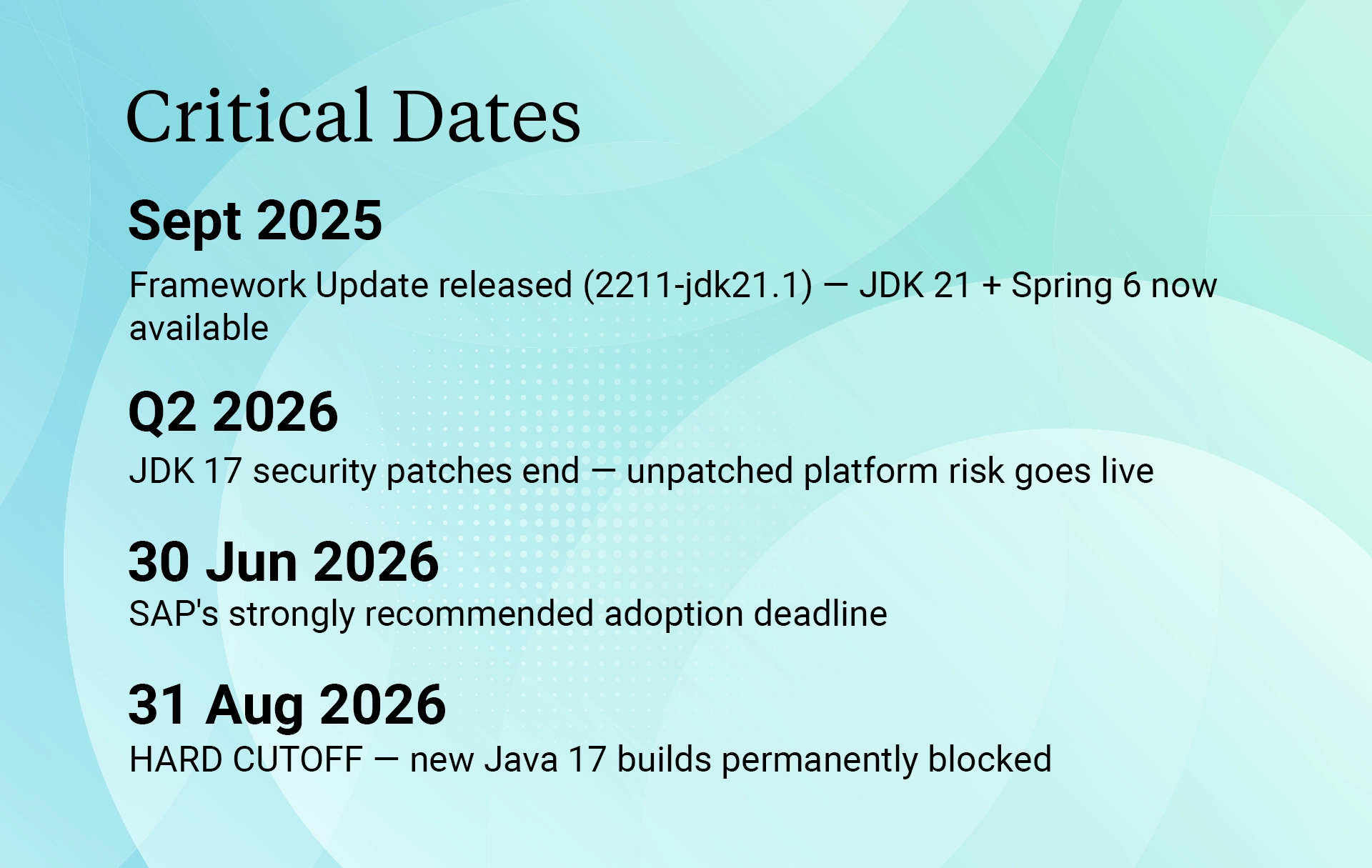
SAP has been clear: customers still on JDK 17 as of the August 2025 update received an extended window — security fixes until end of Q2 2026, and a hard final deadline of August 31, 2026 to complete the Framework Update. Miss that date and your CI/CD pipelines stop working. Deployments fail. Revenue-critical features cannot be released.
Two Deadlines You Cannot Afford to Miss
SAP strongly advises adoption of the Framework Update by June 30, 2026, when the final Java 17 release hits end-of-support. The absolute last date to complete the migration before build blocking begins is August 31, 2026.
What Exactly Changed — and Why It Matters
The 2211-jdk21 Framework Update is more than a version bump. Here is what SAP fundamentally changed under the hood:
- Java 21 LTS — Virtual threads (Project Loom), pattern matching, and performance improvements that directly translate into lower infrastructure costs and faster response times for your storefront.
- Spring 6 & Spring Security 6 — Migration from Spring Security OAuth (End-of-Life 2022) to Spring Authorization Server. Resource Owner Password Flow and Implicit Flow are removed in line with modern OAuth best practices.
- Jakarta EE namespace migration — All javax.* imports move to jakarta.*. Custom code written against old namespaces must be updated.
- Drools upgraded from v8 to v10 — Required due to Spring 6's incompatibility with the old Drools version.
- Removal of deprecated extensions — Cockpit-related extensions (admincockpit, cmscockpit, etc.) were removed in Q3 2025. Accelerator storefronts are scheduled for removal in Q3 2028.
- Node.js 20 End of Support (Jan 2026) — Composable Storefront customers must also migrate to Node.js 22, and to Angular 21 from February 2026.
SAP has also provided OpenRewrite automation recipes to assist with code refactoring — but these handle only a portion of the migration. Custom code, integrations, and platform-specific configurations require experienced hands.
The Six Risks of Doing Nothing
Delaying the Framework Update is not just a compliance issue. It is a direct business risk. Here is what non-action looks like at the platform level:
|
🚫 Build & Deployment Failures Post-Aug 31, 2026, SAP Cloud Portal will block all new builds on JDK 17. You lose the ability to ship features or hotfixes. |
🔓 Unpatched Security Vulnerabilities JDK 17 security patches end Q2 2026. Running an unpatched e-commerce platform is a critical liability for your customers and your regulators. |
|
📉 Revenue Erosion Inability to deploy means inability to respond to market demands, launch campaigns, or fix conversion-killing bugs. Every sprint blocked is revenue lost. |
🏚 End of Dedicated SAP Support SAP's Continuous Innovation model rewards current customers. Falling behind means falling out of the support safety net entirely. |
|
🔄 Innovation Lockout New SAP features — AI-powered commerce, Open Payment Framework, headless innovations — are only available on the current framework. |
🏁 Competitive Disadvantage Competitors who upgrade will deploy faster, serve customers better, and leverage AI-driven capabilities that are simply unavailable to you. |
The Akkodis Upgrade Approach: From Assessment to Go-Live
At Akkodis, we have delivered SAP upgrades across industries — manufacturing, retail, high-tech, life sciences, and beyond. Our SAP Commerce practice brings structured, risk-controlled methodology to every Framework Update engagement.
Step 1 — Rapid Assessment & Gap Analysis
We audit your current platform — custom extensions, deprecated usages, OAuth flows, Accelerator components, and third-party integrations — and produce a clear picture of migration scope, risk, and timeline in days, not weeks.
Step 2 — Automated Code Modernisation with OpenRewrite
We apply SAP's OpenRewrite recipes intelligently — handling namespace migrations, deprecated API replacements, and build file updates — while our senior architects review what automation cannot safely handle.
Step 3 — Custom Code Adaptation & Integration Review
All custom extensions are updated against JDK 21 and Spring 6 constraints. OAuth flows are migrated to Authorization Code Flow. All integration touchpoints are validated against the new framework.
Step 4 — Regression Testing & UAT
Our QA team runs comprehensive regression suites in staging environments. We work alongside your team for UAT, ensuring nothing slips through before go-live approval.
Step 5 — Go-Live & Hypercare
Deployment is executed with a risk-mitigated go-live strategy, supported by a dedicated hypercare period — so your team has full confidence in the new environment from day one.
Your Upgrade Timeline: How Tight Is It Really?
The honest answer: it depends on the complexity of your implementation. But the time to start is now, not when the deadline is imminent.
A typical Akkodis Framework Update engagement — from kick-off to go-live — runs 8 to 14 weeks, depending on customisation depth. If your platform has significant custom extensions, bespoke OAuth integrations, or Accelerator-based storefronts, you need to act now to stay safely inside that window.
Beyond Compliance: The Business Case for Upgrading Now
We understand the pressure of squeezing an unplanned upgrade into a packed roadmap. But framing the JDK 21 Framework Update as purely a compliance exercise misses the strategic upside.
- Performance gains — Java 21 virtual threads mean your platform handles more concurrent shoppers with lower infrastructure spend.
- Access to AI-powered features — Intelligent merchandising, composable storefront innovations, and Open Payment Framework are only available on the current JDK 21 track.
- Simplified ongoing maintenance — SAP's Continuous Innovation cadence delivers monthly updates with bug fixes, security patches, and feature unlocks.
- Developer experience improvements — Modern Java tooling, Spring 6 patterns, and a cleaner codebase mean faster feature delivery and lower technical debt.
- Strengthened security posture — Modern OAuth flows, up-to-date dependencies, and JDK 21's enhanced security architecture reduce your attack surface.
This upgrade is not a cost centre — it is a competitive enabler. The teams that move first will build on a faster, more intelligent platform while their peers are still firefighting legacy constraints.
Why Akkodis — And Why Now
Akkodis is a global leader in digital engineering and technology transformation, with a dedicated SAP practice spanning implementations, upgrades, and managed services. As a recognised SAP partner, we have helped enterprises across sectors navigate complex platform transitions — combining deep technical expertise with the commercial discipline to deliver on time and within scope.
Our SAP Commerce specialists bring hands-on experience with the JDK 21 Framework Update — from OpenRewrite automation to Spring 6 OAuth migration to Composable Storefront modernisation. We are not learning on your dime; we have been here before.
The question is not whether you need to upgrade. SAP has answered that. The question is who you trust to do it right, and whether you start early enough to do it well.
Don't Let August 31st Catch You Off Guard
The JDK 21 Framework Update is one of the most significant SAP Commerce Cloud changes in years. Akkodis has the expertise, methodology, and track record to get you there — safely, on time, and ready for what comes next.