One AI Engine, 2–5x More Clicks — The SAP Intelligent Selling Services Playbook for SAP Commerce Cloud
How ISS turns every recommendation, search result, and merchandising decision into a personalised revenue driver
12 minutes
2nd of July, 2026
.webp?h=auto&w=100%25&hash=89EDAE48D83795B0108F48FB1C3D8B41)
Turn Every Click Into a Conversion.
The AI Engine Inside SAP Commerce Cloud.
SAP Intelligent Selling Services (ISS) personalises every product recommendation, every search result, and every merchandising decision — in real time, for every individual shopper. It doesn’t guess what customers want. It learns from how they behave. And it converts.
|
11x Gartner MQ Leader Digital Commerce, 2025 |
2–5x Recommendation CTR vs static bestseller lists* |
10–20% Search-to-Cart Lift adaptive search vs Solr* |
5–15% Average Order Value via contextual cross-sell* |
*Directional ranges reported by SAP implementation partners (Spadoom), not guaranteed outcomes. Actual results depend on catalog size, traffic volume, and personalisation maturity. See “The Numbers” section for context.
ISS IN 30 SECONDS
ISS is a separate, AI-powered cloud service that runs alongside SAP Commerce Cloud. It watches how shoppers behave in real time, runs that signal through machine-learning models, and hands back personalised recommendations and search rankings via API — without adding latency to your storefront. Three modules (Foundation, Merchandising, Recommendation) cover the whole loop, from raw behavioural data to the carousel a customer actually sees. It’s embedded in your Commerce Cloud subscription, configurable by business users with no code, and proven at scale: SAP has been a Gartner Magic Quadrant Leader for Digital Commerce 11 times running.
Why ISS Exists: The Problem With “Same Results for Everyone”
Most e-commerce platforms run on a simple, dumb contract: type a query, get the same results as everyone else. They show the same bestsellers to a first-time visitor and to a loyal buyer with 50 orders. They recommend products that are out of stock. They have no memory of what a shopper looked at three pages ago. Every visitor gets the average experience — and the average experience converts like the average.
SAP Intelligent Selling Services was built to break that contract. It is not a feature buried inside SAP Commerce Cloud. It is a dedicated cloud service that runs alongside Commerce Cloud, ingests behavioural events from the storefront in real time, processes them through machine-learning models, and returns personalised results via API. Recommendations, search rankings, category-page ordering, merchandising rules — all of it adapts to the individual, and none of it slows your storefront down.
This is where SAP’s commerce AI shows up in practice. As of its Q3 2024 results, SAP reported more than 34,000 customers using SAP Business AI across its portfolio — and ISS is one of the most direct ways that AI reaches a live storefront. The best part: it’s available now, embedded in your existing SAP Commerce Cloud subscription.
Sources: SAP — 34,000 Business AI customers (Q3 2024) | SAP News — 11x Gartner MQ Leader, Digital Commerce (2025)
The Three Modules That Power ISS
ISS is one system with three jobs: understand the shopper, let the business shape the experience, and serve the right product at the right moment. Each job is a module — and they feed each other in a continuous loop.
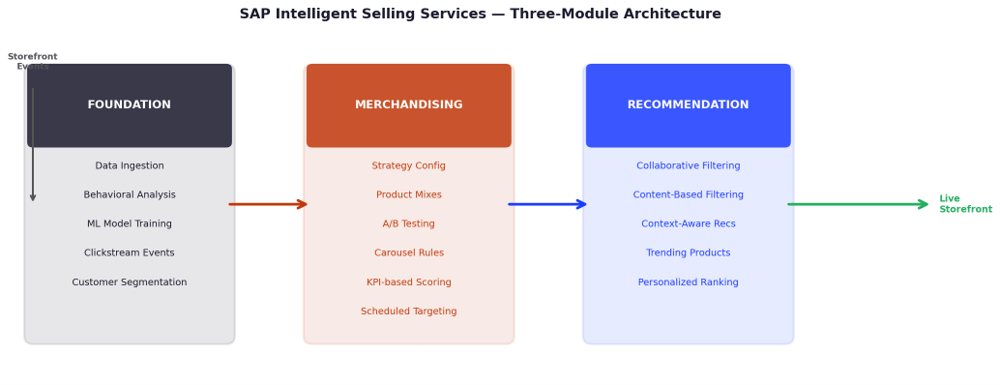
Figure 1: The ISS three-module architecture — Foundation feeds Merchandising feeds Recommendation, all returning to the live storefront.
Module 1 — Foundation: The Intelligence Layer
Foundation is the data brain. It collects behavioural events from your storefront in real time — page views, search queries, clicks, add-to-carts, purchases, and any custom event you configure — and runs them through ML algorithms to build individual customer profiles, identify behavioural segments, and learn the patterns that predict purchase intent.
- Real-time behavioural ingestion: every action on the storefront feeds Foundation as it happens. Models update continuously — no nightly batch job, no lag between behaviour and response.
- Customer segmentation: Foundation groups shoppers by behaviour, enabling segment-level targeting that goes well beyond basic demographics.
- Predictive scoring: every product is scored against each customer’s current context and history — the probability signal that drives both recommendations and search ranking.
- KPI-based product scoring: products are also scored against business KPIs (conversion rate, click rate, add-to-cart rate, revenue per view), so commercial performance influences what gets surfaced — not just individual relevance.
Sources: SAP Community — ISS Personalisation for Commerce Cloud | SAP Learning — Understanding ISS
Module 2 — Merchandising: The Control Layer
Merchandising is where business users meet the AI. It’s a no-code, cloud-native interface that lets merchandisers and category managers control how ISS behaves on each storefront — without raising a ticket with IT.
- Strategies: the core unit of configuration. A strategy combines ML algorithms and business rules to decide what ISS shows in a given context (homepage, category page, PDP, cart). Create many, and assign them to different pages, segments, or time windows.
- Product mixes: a curated collection of products inside a strategy — AI-driven, manually curated, or hybrid. Pin specific products, boost new arrivals, or suppress out-of-stock items from ever appearing.
- A/B testing: run two strategies head to head. Does collaborative filtering beat manual curation for your catalog and customers? ISS gives you the data to decide — with your numbers, not a vendor’s slide.
- Scheduled targeting: activate strategies automatically at set times — seasonal promotions, flash-sale carousels, and time-sensitive pushes with zero manual intervention.
- Trending search terms (Dec 2025): merchandisers can now see trending search terms inside the ISS business tooling before they appear on the storefront. Terms are calculated from the last 24 hours of traffic and refreshed at least hourly; unwanted terms can be excluded to keep search on-brand.
- Keyword action sets (Dec 2025): create keyword-based action sets that redirect shoppers straight to a chosen destination — a landing page, category, or promotion — bypassing the regular search results entirely.
Sources: SAP Learning — Innovations in ISS (Dec 2025 features) | SAP Help Portal — Intelligent Selling Services
Module 3 — Recommendation: The Conversion Layer
Recommendation is the output — the personalised carousels, cross-sell suggestions, and search rankings the customer actually sees. It draws on Foundation’s ML models and Merchandising’s configured strategies to put the right product in front of the right shopper at the right moment.
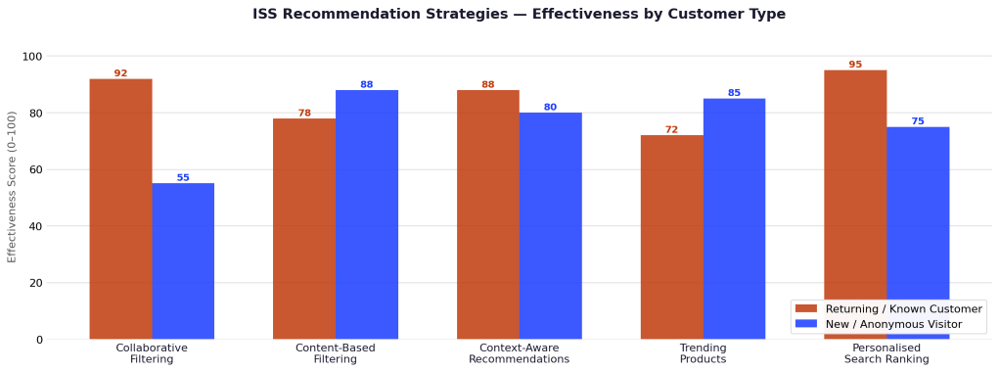
Figure 2: ISS recommendation strategies — which mechanism works best depends on whether the shopper is a returning customer or a new/anonymous visitor.
- Collaborative filtering: the classic “customers who bought X also bought Y.” Draws on purchase patterns across your whole base — the more transaction volume, the sharper the signal. Best for returning customers with history.
- Content-based filtering: recommends products with similar attributes (category, brand, price band, spec profile) to what a shopper viewed or bought. Works with little or no purchase history — ideal for new visitors.
- Context-aware recommendations: the recommendation changes with the shopper’s position in the journey. Homepage discovery, cart cross-sell, and order-confirmation repurchase are fundamentally different jobs — ISS switches automatically.
- Trending products: surfaces products with rising demand — seasonal items, launches, or anything catching momentum — detected from behavioural data without manual tagging.
- Product filtering: out-of-stock items are excluded automatically. ISS checks live inventory before rendering a carousel, so you never recommend something a customer can’t buy.
Sources: Spadoom — ISS AI Personalisation Guide | GoWide — SAP ISS Features and Benefits
THE ARCHITECTURE THAT MAKES IT WORK
ISS runs separately from the SAP Commerce Cloud application server — by design. The ML computation happens outside the storefront runtime, so personalisation never adds latency to a page load. And each Commerce Cloud virtual store is paired with its own dedicated ISS site, giving every storefront an independent catalog, strategy set, merchandising configuration, and reporting dashboard.
Adaptive Search: Same Query, Different Results for Every Shopper
Standard Solr search — Commerce Cloud’s default — is a catalog lookup. It returns the same results to everyone who types the same query, ranked the same way. It’s fast and deterministic. It also leaves a lot of conversion on the table.
Adaptive search, powered by ISS integrated with the SAP Commerce Cloud Search Service, adds a personalisation layer on top. The same query returns different results for different customers, ranked by individual relevance instead of global popularity.
How personalised ranking works
Two customers search “running shoes.” Standard Solr gives both the same list in the same order. ISS reads each shopper’s history and reorders accordingly:
- Customer A has browsed trail gear and viewed hiking content — ISS surfaces trail shoes first.
- Customer B has read marathon content and bought road apparel — ISS surfaces road shoes first.
Same query. Different intent. Different results. The personalisation is invisible — the shopper just feels like your search “gets” them better than everyone else’s.
Behavioural boost
Products a customer has previously viewed, carted, or bought in the same category get a relevance boost — enough to lift the most individually relevant options toward the top, without collapsing into a filter bubble.
Merchandiser rules still rule
Adaptive search respects the rules set in the Merchandising module. Boost new arrivals across all results, promote high-margin lines, suppress specific SKUs, or pin results to specific queries. AI-driven personalisation and the business-rules layer interact — so merchandisers keep meaningful control over what the AI surfaces.
A/B testing for search
Run A/B tests on search configuration — AI-driven ranking versus manual curation or alternative strategies — to prove adaptive search is improving conversion for your catalog and customers, in your numbers rather than in theory.
Sources: SAP Learning — Transforming Search with ISS & Search Service | SAP Community — Integrating ISS into Commerce Cloud 2211
CRITICAL DEPENDENCY: ISS + SEARCH SERVICE
Personalised search is available only when SAP Commerce Cloud is integrated with both Intelligent Selling Services and the SAP Commerce Cloud Search Service. It is not available with the default Solr facet search provider. Plan this architectural decision into your ISS roadmap from the outset.
The Numbers: What ISS Actually Moves
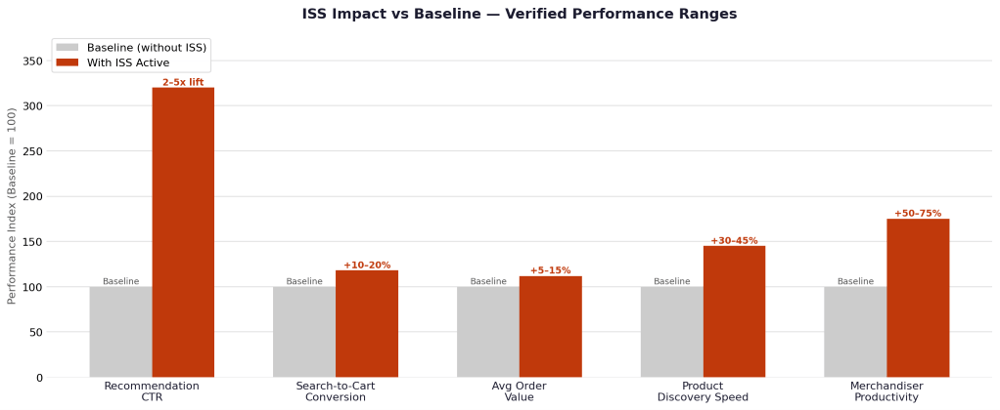
Figure 3: ISS impact vs baseline — directional performance ranges reported across ISS deployments (Spadoom). Not guaranteed outcomes.
These are the performance ranges ISS-enabled deployments tend to see versus a static baseline, as reported by SAP implementation partners. They are directional, not guaranteed — catalog size, traffic volume, and prior personalisation maturity all move the needle. Treat them as what “good” can look like, then validate with your own A/B tests:
- Recommendation click-through rate — 2 to 5x: versus static bestseller lists. The range reflects the gap between small catalogs with thin history and large catalogs with rich behavioural data.
- Search-to-cart conversion — +10 to 20%: with adaptive search versus standard Solr on equivalent traffic, earned through personalised ranking that shortens the path to the right product.
- Average order value — +5 to 15%: through contextual cross-sell, especially on the cart and order-confirmation pages — a relevant nudge at peak purchase intent beats a generic bestseller every time.
- Product discovery speed: a measurable drop in pages-to-product for personalised search, which correlates directly with lower bounce and higher add-to-cart rates.
- Merchandiser productivity: no-code tooling with scheduled strategies, A/B testing, and automated trending-term management cuts the manual effort of keeping a storefront performing.
Sources: Spadoom — ISS Personalisation Guide (metrics) | Gartner — 67% of B2B buyers prefer a rep-free experience (2026)
WHY THIS MATTERS FOR B2B
Gartner’s latest sales survey found 67% of B2B buyers now prefer a rep-free buying experience, and 45% already used AI during a recent purchase. When buyers self-serve, your storefront has to do the job a great sales rep used to do — anticipate needs, surface the right options, and build confidence. ISS is that rep, at infinite scale.
Capability Coverage: Five Dimensions, One System
ISS spans five core capability dimensions. Knowing where each is strongest — and where it needs extra configuration investment — is how you set the right activation priorities.
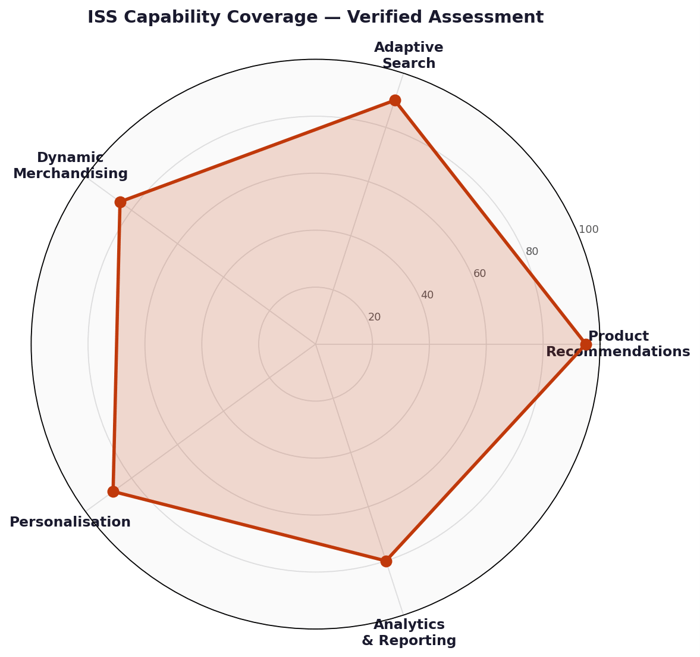
Figure 4: ISS capability radar — product recommendations and adaptive search lead, with merchandising, personalisation, and analytics completing the picture.
Product recommendations — strongest
Collaborative filtering, content-based filtering, context-aware recommendations, and trending products are all production-proven and configurable directly in the Merchandising module. This is where most deployments start and where the fastest ROI shows up.
Adaptive search — high impact, one dependency
Highly effective, but requires integrating the SAP Commerce Cloud Search Service. Once in place, personalised ranking is among the most commercially impactful features in the whole ISS suite.
Dynamic merchandising — production-ready
Strategy configuration, product mixes, A/B testing, and scheduled targeting are all production-ready. The December 2025 updates to trending-term management and keyword action sets materially strengthened this dimension.
Personalisation — strong at the behavioural level
ISS personalises against observed behaviour and is strong at anonymous and session-level personalisation. It does not yet natively integrate with SAP Customer Data Platform for identity-resolved, profile-level personalisation — that requires additional configuration.
Analytics & reporting — sufficient, extensible
ISS reports on audience coverage, click-through rate, real-time response, and conversion ratio per strategy — enough for day-to-day merchandising decisions. For deeper cross-channel analysis, integrate SAP Analytics Cloud or SAP Business Data Cloud.
Sources: SAP Community — Commerce Cloud Q4 2025 Release Highlights | SAP Help Portal — About Intelligent Selling Services
Compatibility & Setup: What to Know Before You Start
Storefront compatibility
ISS integrates with three Commerce Cloud storefront configurations:
- B2C Composable Storefront: the preferred, recommended path for new deployments and post-Accelerator migrations.
- B2B Composable Storefront: full ISS compatibility for B2B commerce, including bulk availability queries via the Shopping Agent integration.
- B2C Accelerator: supported, but on a deprecation clock — the final Commerce Cloud update containing the deprecated Accelerator UI ships in Q2 2027, with mainstream maintenance ending in 2028. Any new ISS integration on the Accelerator should come with a composable-storefront migration plan.
Multi-site architecture
Each Commerce Cloud virtual store is paired with its own dedicated ISS site. That isn’t a limitation — it’s a strength: every site gets an isolated catalog, strategy set, merchandising configuration, and reporting, so each storefront can serve its own audience and be optimised for its own KPIs.
Extensions & add-ons
Composable storefront integrations include the merchandising module for integration configuration. Accelerator-based storefronts additionally require the profiletagaddon, merchandisingaddon, and merchandisingstorefrontsampledataaddon add-ons.
Personalised search — the one extra dependency
Personalised search is the single ISS feature that needs an extra service: the SAP Commerce Cloud Search Service must be integrated alongside ISS. Customers on standard Solr facet search cannot access personalised ranking without this architectural change — plan it into the roadmap from day one.
Sources: SAP KBA 3263872 — Accelerator Storefront Deprecation FAQ | SAP Help Portal — End of Mainstream Maintenance for SAP Commerce
Is ISS Right for You? (And When It Isn’t)
ISS is powerful, but it isn’t magic, and it isn’t for every situation on day one. Here’s the honest read.
ISS is a strong fit when…
- You’re already on SAP Commerce Cloud — ISS is embedded in your subscription, so activation is configuration, not a new platform purchase.
- You have real traffic and transaction volume — ML models sharpen with data. The more behavioural signal you feed Foundation, the better recommendations and ranking get.
- Business users want control without IT tickets — the no-code Merchandising module is built for merchandisers and category managers.
- You can commit to A/B-test discipline — the teams that win with ISS treat it as an optimisation programme, not a one-time switch.
Hold off, or plan carefully, when…
- Your catalog data is messy — incomplete attributes and inconsistent data degrade model quality. Fix the catalog first (see “What ISS Is Not” below).
- You need profile-level identity resolution today — native SAP Customer Data Platform integration isn’t there yet; ISS is strongest at behavioural and session-level personalisation.
- You want personalised search but aren’t ready to adopt the Search Service — it’s a hard dependency, so budget the integration up front.
WHAT ISS IS NOT
ISS is not a substitute for a well-structured product catalog with complete attributes and clean data. Machine-learning models are only as good as the data they train on. Before activating ISS, assess catalog completeness, attribute consistency, and event-tracking accuracy — Akkodis makes this Phase 1 of every engagement.
Frequently Asked Questions
Is ISS a separate product I have to buy?
ISS is a dedicated cloud service that runs alongside SAP Commerce Cloud and is embedded in the Commerce Cloud subscription. You activate and configure it rather than buying a separate platform. (Confirm exact entitlement with your SAP account team.)
Will ISS slow down my storefront?
No. ISS runs its ML computation outside the Commerce Cloud application server and returns results via API, so personalisation doesn’t add latency to page loads.
Do I need the Search Service for everything?
Only for personalised search ranking. Recommendations, dynamic merchandising, and A/B testing work without it. Personalised search specifically requires the SAP Commerce Cloud Search Service in addition to ISS.
Does ISS work for B2B?
Yes. ISS supports the B2B Composable Storefront, including bulk availability queries via the Shopping Agent integration, with B2B-specific recommendation contexts.
How does ISS handle new or anonymous visitors?
Content-based filtering and trending products work with little or no purchase history, so new and anonymous shoppers still get relevant, personalised results from their first few clicks.
Can business users control the AI, or is it a black box?
Business users keep control. The no-code Merchandising module lets merchandisers pin, boost, suppress, schedule, and A/B-test — and those rules interact with the AI-driven personalisation.
What changed in the December 2025 release?
Two merchandiser-facing additions: trending search terms now appear inside the ISS business tooling (calculated from the last 24 hours of traffic, refreshed at least hourly) with the ability to exclude unwanted terms; and keyword action sets can redirect shoppers straight to a chosen destination, bypassing regular search results.
How long does activation take?
A standard activation (Recommendations + Merchandising + A/B Testing) typically runs 6–10 weeks; full activation including Personalised Search via the Search Service runs 10–16 weeks. Multi-site enterprise rollouts are scoped individually.
How Akkodis Activates ISS — From Kick-Off to Revenue
Configuring ISS technically is one thing. Making it deliver revenue is another. The difference is strategy design, catalog readiness, event-tracking accuracy, A/B-test discipline, and ongoing optimisation. The Akkodis SAP Practice brings a structured, commercially-minded methodology that gets from kick-off to measurable results in weeks.
Phase 1 — Catalog & Data Readiness Audit (2 weeks)
We audit your catalog for attribute completeness, data consistency, and event-tracking coverage, identify the gaps that would impair model quality, and fix them before activation. Output: a clear data-readiness scorecard and remediation plan.
Phase 2 — ISS Site Setup & Integration (2–4 weeks)
We configure ISS sites for each virtual store, integrate with the storefront and (where applicable) the Search Service, validate event tracking, and establish the initial strategy configuration. For B2B, we set up the multi-site architecture and B2B-specific recommendation contexts.
Phase 3 — Strategy Design & A/B Framework (2–3 weeks)
We design strategies for each key context — homepage discovery, category browsing, PDP cross-sell, cart cross-sell, post-purchase — and stand up the A/B framework that lets you iterate on real data instead of assumptions.
Phase 4 — Personalised Search Integration (2–4 weeks, if applicable)
If you’re adopting the Search Service to unlock personalised search, we manage that integration alongside ISS activation — search relevance configuration, merchandising rules for search, and keyword action set setup.
Phase 5 — Go-Live, Measurement & Optimisation
Phased go-live with commercial KPI baselines locked in before launch. We measure recommendation CTR, search-to-cart conversion, and AOV against the pre-ISS baseline, report weekly through the first month, and refine strategies on live performance data.
TYPICAL AKKODIS ISS ACTIVATION TIMELINE
Standard activation (Recommendations + Merchandising + A/B Testing): 6–10 weeks from kick-off to go-live. Full activation including Personalised Search via the Search Service: 10–16 weeks. Multi-site enterprise deployments are scoped individually based on the number of virtual stores and regional complexity.
Your commerce platform should know your customers better than they know themselves.
Akkodis SAP Practice configures, integrates, and optimises ISS for SAP Commerce Cloud across B2B and B2C — from strategy and A/B frameworks to personalised search and multi-site rollout. We make ISS deliver measurable revenue impact from day one.