No Changes, Please: Recreating a Legacy Maritime System with Modern Technology
When innovation means making sure nothing changes.
5 minutes
21st of August, 2026
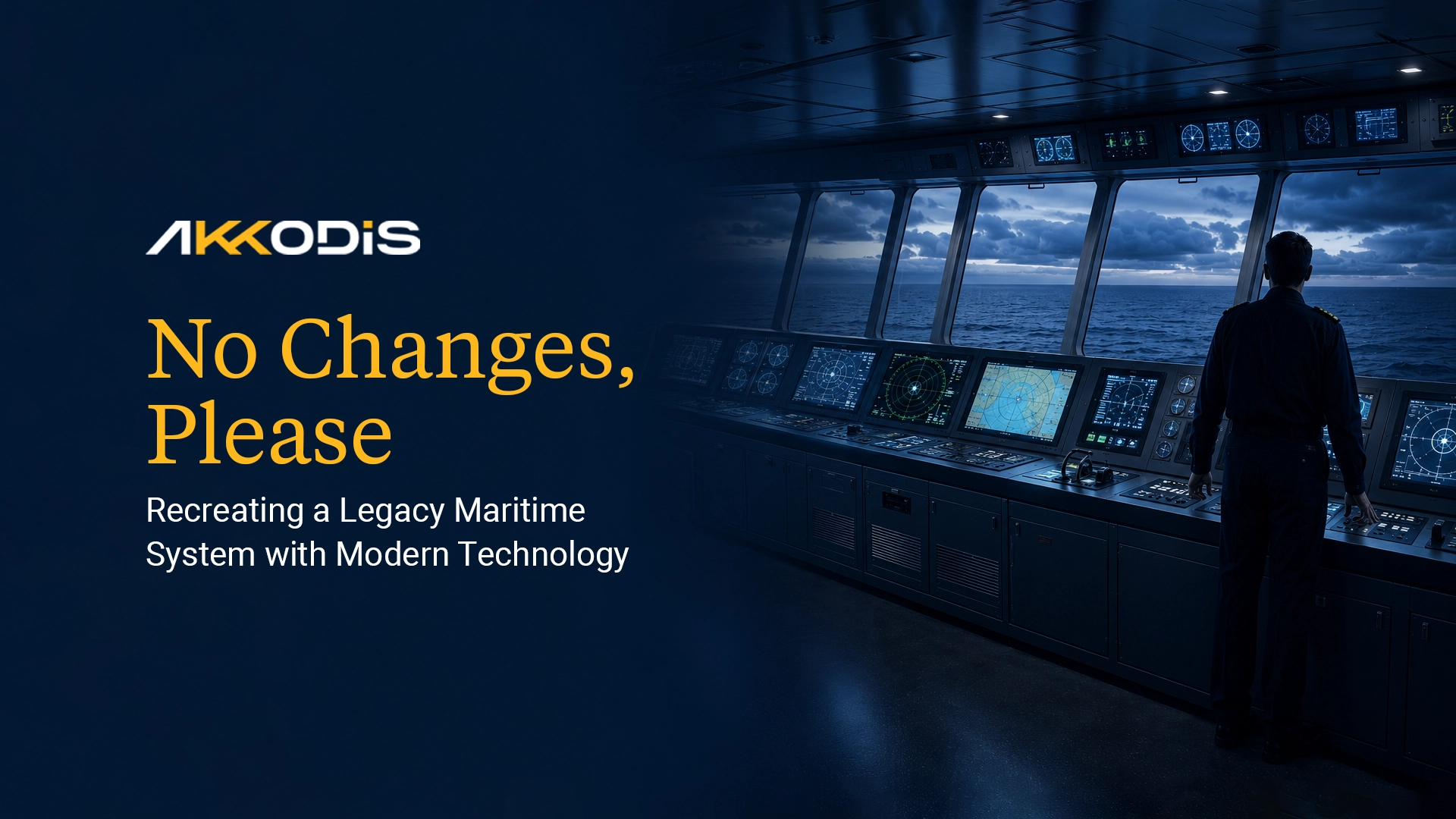
In technology, progress is often measured by what is new. Faster processors, smarter software, and more connected systems constantly push industries forward. But sometimes, the most valuable innovation is one user never notices.
That is the challenge facing an Akkodis engineering team working on a maritime bridge system. Their mission is unusual: rebuild a decade-old system using modern hardware and software components while ensuring the end result looks, feels, and performs exactly like the original.
For the customer, success means one thing: no changes.

Our job is to make unavoidable technological changes invisible. What matters most is that users trust the system to perform exactly as they expect.
Peter Oliva, Software Project Leader, Akkodis
The Importance of Familiar Technology at Sea
For crews operating large vessels, reliability is far more important than novelty.
The bridge is the operational heart of a ship, bringing together information from multiple systems, including:
- Gyrocompasses
- Autopilots
- Radar systems
- Electronic Chart Display and Information Systems (ECDIS)
From this environment, navigators manage the vessel's course, speed, and safety. During critical situations, operators rely heavily on technology they know and trust. Even small interface changes can introduce uncertainty when rapid decisions are required. That is why many maritime operators value consistency just as much as innovation.
A Bridge System That Got Everything Right
One of Akkodis' maritime technology clients specializes in delivering integrated bridge systems for vessels around the world.
Roughly ten years ago, the company deployed a bridge solution across a fleet of ships. The reception from users was exceptional. The system was intuitive, reliable, and closely aligned with established onboard workflows. Unlike many technology projects that immediately generate enhancement requests, this solution earned something rare: complete user acceptance.
Years later, the customer requested additional systems.
There was just one condition.
The new systems had to be identical to the originals.
Not similar.
Not improved.
Identical.
According to Peter Oliva, Software Project Leader at Akkodis, such a request is highly unusual.
Most systems generate requests for updates or improvements over time. In this case, the users were extremely satisfied with the original solution and wanted the exact same experience.
The Obsolescence Challenge
While replicating an existing system may sound straightforward, modern engineering realities make it remarkably complex. A decade is a long time in the technology world.
Processors, displays, chipsets, operating systems, and communication components routinely reach end-of-life status. Many of the parts used in the original design are no longer available.
As a result, rebuilding the platform requires an extensive obsolescence mitigation effort.
Ideally, we would simply deploy the original system again. But hardware and software evolve rapidly, and many of the components used in the original solution are no longer available.
Peter Oliva, Software Project Leader, Akkodis
The objective is therefore not modernization in the traditional sense.
The objective is invisible modernization.
Modern technology must replace obsolete components without changing the experience for the people who depend on the system every day.
When Every Component Depends on Another
The challenge extends well beyond finding replacement parts. Modern maritime bridge systems are complex ecosystems where hardware and software operate as part of a larger interconnected environment. A change in one component can trigger unexpected consequences elsewhere.
A replacement device may not communicate correctly with an existing interface. A software application may require hardware that is no longer supported. A new component may force changes in several connected subsystems.
The Akkodis team is therefore conducting a detailed analysis of every element within the solution, evaluating:
- Hardware availability
- Software compatibility
- System interoperability
- Long-term maintainability
- Integration requirements
This work requires close collaboration with multiple project stakeholders and technology providers to ensure every dependency is properly managed. As Peter explains, replacing a single component can often create a cascade of additional engineering challenges. What initially appears to be a simple substitution can quickly become a complex systems integration exercise.
Engineering ContinuityThrough Change
The project brings together software specialists, embedded systems engineers, and hardware experts focused on maintaining continuity while navigating technological evolution.
Currently in the analysis phase, the initiative will eventually lead to the development of updated hardware and software platforms capable of replacing the original system without disrupting user workflows.
Will the final result be an absolutely perfect replica?
Probably not.
Technology evolves too quickly for that.
But the objective remains unchanged: ensure users experience the same confidence, reliability, and familiarity they have trusted for years.
For Akkodis, that means applying advanced engineering expertise not to create something new, but to preserve something proven.
Transforming Obsolescence into Opportunity
Obsolescence is one of the biggest challenges facing organizations that depend on long-lifecycle systems, particularly in industries such as maritime, transportation, defense, and industrial manufacturing.
Balancing modernization with operational continuity requires deep expertise across hardware, software, integration, and systems engineering.
At Akkodis, helping clients navigate that balance is part of what we do every day.
Because sometimes innovation is not about changing everything. Sometimes innovation is ensuring that everything keeps working exactly as it should.
