In the AI Era, Experience Paves the Way
Akkodis Director Yukie Okuda and NTT Executive Member of the Board Sachiko Oonishi on the Value of “Just Try It First”
6 minutes
4th of March, 2026
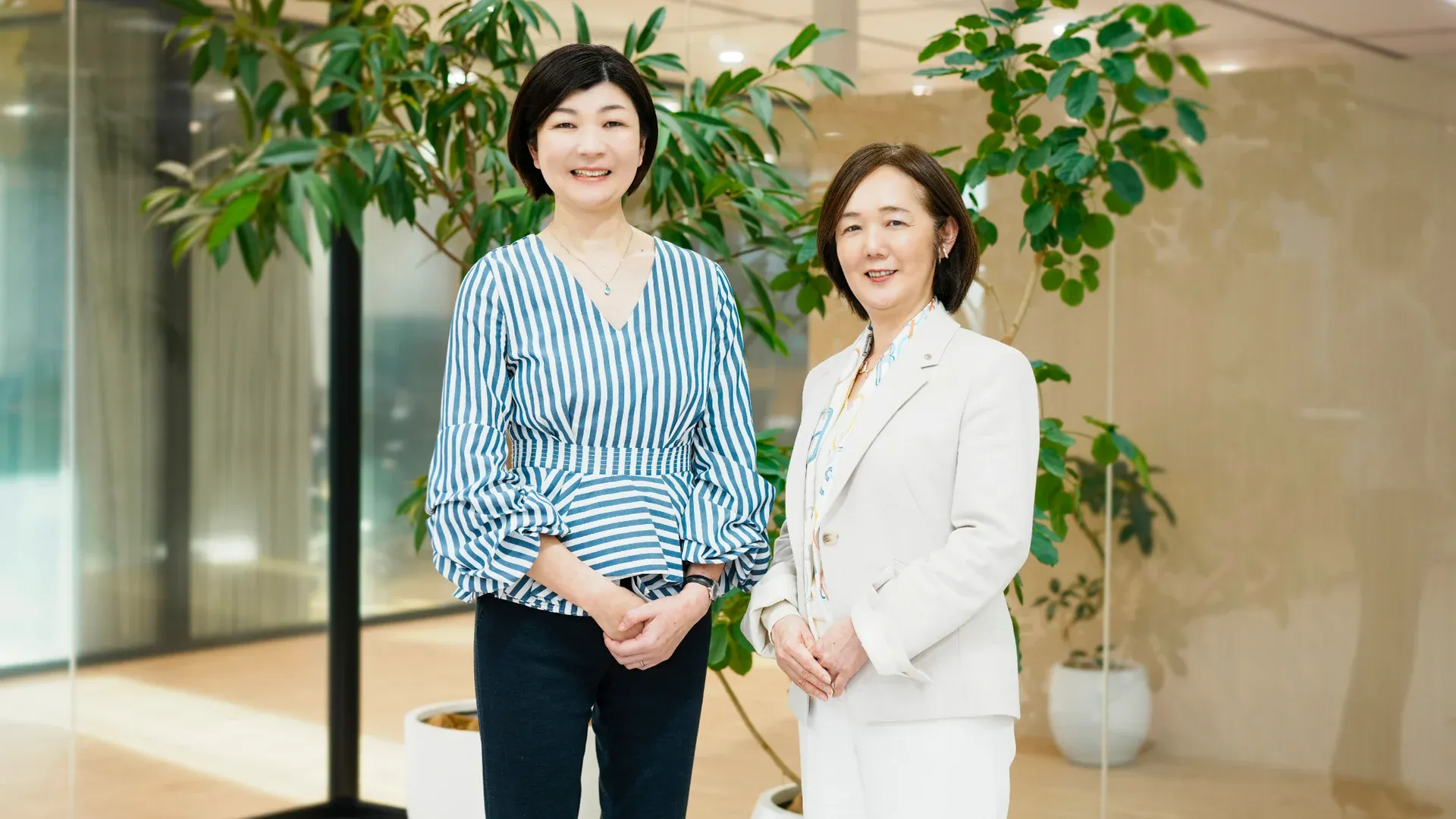
Yukie Okuda, on the Board of Directors at Akkodis Consulting, drives its HR strategy from a global perspective. Sachiko Oonishi is an Executive Member of the Board at NTT, one of Japan’s leading global IT companies. Though their careers have taken different paths, both are women leaders who have broken through organizational barriers to open up uncharted territory. Drawing on their own experience, they discuss the importance of speaking in your own words, and the agile approach to career-building captured in the idea of “just try it first,” in an AI era that offers no single correct answer.
Leadership Forged With No Predecessor to Follow
Okuda In 2024, you became NTT’s first female Executive Member of the Board. Could you tell us about your current mission and the specific areas you oversee?
Oonishi My mission is to create new value and generate sustainable business for the NTT Group. To do that, I’m strengthening three functions and using them to drive business creation: innovative R&D that contributes strongly to the business, new business creation through alliances (co-creation) with other companies, and marketing from the customer’s point of view. As a director at Akkodis, what role do you play?
Okuda I have two main roles. One is as the HR lead in Japan: Director of Akkodis and Head of the People Success Division. The other is driving global talent strategy as HR lead for the APAC region, covering Singapore and China.
Oonishi I understand you came from a consulting firm and have spent a long career in HR. Why did you choose Akkodis?
Okuda Because I was drawn to the potential of Akkodis. Consulting firms in general tend to stay in a third-party position, but Akkodis tech consultants*1 have a real strength: they go deep into the client’s workplace and, while taking on the actual work, support transformation and improvement together with the client. I also felt that by drawing on the group’s global assets, we could give even stronger support to Japanese companies aiming to expand their business worldwide. That’s what made me decide to join.
By the way, I understand you worked on launching new services such as “FLET’S,” and that around 70% of your career has been in new areas with no predecessor to learn from. Was that a path you chose yourself?
Oonishi No, it wasn’t something I chose myself. Under the personnel practices of the time, core departments had established career paths, and women tended to be given “new fields and new businesses” relatively often, because there was no need to compete over existing posts. At the time, I didn’t think much about why I kept being moved to new organizations, but later, a female HR executive at a foreign-affiliated company pointed out to me, “Your career is exactly that,” and I thought, ah, so that’s one way to see it. In the end, being able to build experience in new fields with no predecessor became the foundation of my career today, and I’m very grateful for it.
“Think Through the Essence and Purpose, Then Build It”: Dynamism on the Front Line
Okuda What project stands out most in your memory?
Oonishi It has to be launching “FLET’S,” the flat-rate internet connection service. It was a first in every sense: my first time as a manager and my first time building a collaboration model with internet service providers. On top of that, in the early days of the launch, the providers that NTT saw as partners viewed us, at least on the surface, as having conflicting interests, and we faced fierce opposition from every one of them. The headwind was strong enough that angry emails from provider executives came directly to me, then a section manager in charge of the project.
Okuda How did you break through that situation?
Oonishi Because it was something that threatened to shake the very foundation of the FLET’S launch, I skipped the usual hierarchy, emailed the vice president directly, and built a mechanism to share the voices of providers and customers with management immediately. That became the breakthrough, and the organization began to move dramatically. We built trust with each provider as a partner in creating the market together, and even as we worked through the huge volume of complaints and organizational confusion that tend to come with launching a new service, I felt the dynamism of everyone moving as equals. That experience (not simply following the established path, but thinking through the purpose and the essence of things and turning that into form) has sustained me ever since.
Okuda I’ve had a similar experience. At one large company, I pushed through, in a short period, a reform of an evaluation system that had been stalled for two years. To establish a feedback culture built on development plans rather than numbers, I boldly simplified a nine-point rating scale down to three points.
Because evaluations are directly tied to compensation, we faced fierce backlash from the front line. So I went in person to branches and factories around the country and took an “engage everyone” approach, repeating workshops with frontline managers. I explained the intent of the system in my own words, and had people on the ground digest it in their own words, too. Without that dialogue, I don’t think we could have made the system work in a way people genuinely bought into. That experience is the origin of my stance today: that nothing matters more than dialogue with the front line.
Building Organizations That Nurture Inner Confidence and Break Down Bias
Oonishi So you place real value on human sensibility, on “speaking in your own words.” Does that experience carry over into what you’re doing at Akkodis today?
Okuda In careers too, I’ve come to really feel that what matters is the person speaking in their own words, rather than relying on a framework the company has prepared. At Akkodis, “Vision Matching” (putting each employee’s own “life vision and career vision” into words and linking it to their actual work and way of working) sits at the core of our career paths.
Even when the work is at a client’s site, I believe that being able to actually see how you are contributing to the client’s mission is what leads to a way of working people can genuinely buy into.
As an organization, we’re also focused on raising the ratio of women in management. An internal survey we ran in 2025 revealed that many managers and women employees were struggling with biases such as “promotion is difficult because I work reduced hours.” We’re now at the phase of breaking through such assumptions and, together with senior management, promoting the talented people who deliver results regardless of time constraints.
Oonishi At NTT too, we’re advancing the promotion of women, but it’s sometimes misunderstood as favoritism toward women, and quite a few women worry about how that will be perceived and hesitate to become managers. That, in turn, can harden into the bias that “women don’t want to become managers.” In reality, it’s not that they don’t want to become managers: the reasons have more to do with how the job fits their life stage, or with rating themselves too low. When you unpack the sources of anxiety one by one, many women are able to shed their hesitation and say, “I’ll give it a try.”
Honestly, when I myself was appointed to a management position, I was anxious about whether I could really do it. But a role helps a person grow. Trying taught me things I could not have understood otherwise. I became able to do more, my horizons widened, and I saw a new view open up. Experience grows people, and I’ve really felt the importance of encouraging someone to just try it first.
At the same time, NTT West, believing it is also important to notice unconscious bias, developed a tool called “karafuru AI.”*2 It’s a tool that helps people notice hidden biases and habits of thought (such as “women don’t want to become managers”) and prompts a change in behavior; it is already in use at a variety of companies. We’re working to spread awareness of bias across organizational boundaries and build environments where diverse talent can work comfortably, both inside and outside the company.
Okuda That’s a wonderful tool. Actually, like you, I once thought I couldn’t handle management. Many young employees hesitate to take on a challenge because of vague anxiety, but in my experience, having a boss who pushes you to just try it makes a huge difference. And there’s an enjoyment you only discover once you actually try. I want to carefully unpack anxieties one by one and spread that kind of encouragement, “just give it a try,” across the whole organization.
Why Firsthand Experience Matters Most in the AI Era
Oonishi In an age overflowing with information, people unconsciously select the information they need. Put another way, that’s the same as not seeing anything beyond the information they judge to be necessary. But in the AI era, information gets structurally organized for us, so it’s easy to feel like we can see the whole picture, that we understand it. Yet that’s nothing more than “knowing as knowledge.” Information you actually experience and absorb as the person living it is on a completely different level.
For example, before I had children myself, I’d hear from friends, “Pushing a stroller is hard because of the stairs,” and I thought I understood: “That must be tough.” But I didn’t actually remember where the stairs were. Once I became a parent myself, though, it turned from understanding into something felt: I realized just how many curbs and small steps there are around town. Once I started commuting while pushing a stroller, a complete map of where the stairs were began forming in my head. A telling example was when a daycare center was built inside our company. It was built for the sake of employees, and yet there were five steps at the entrance. I’m sure the people involved in the design understood, as knowledge, that it’s better not to have steps, but that knowledge wasn’t reflected in the design. If they’d actually had the experience of pushing a stroller, I don’t think they would have built those five steps.
Okuda Exactly right. There’s a big gap between actually experiencing something and knowing it as information. Even when we make use of AI, I think the final judgment, and the source of innovation, still come from people who have the antennae to sense what doesn’t show up in the data and connect seemingly unrelated elements to create new value.
Oonishi That’s very true. No matter how meticulously a manual is put together from all kinds of information, it can’t match the insight of someone who has actually experienced things on the ground. I felt that firsthand with the NTT Pavilion at Expo 2025 Osaka, Kansai, Japan. We recruited operating staff from 150,000 NTT Group employees across Japan, and around 2,300 took part. Each person served five days, and the whole run was split into 44 shifts. We started with a manual drawn up by the secretariat, but improvement ideas kept emerging out of the actual customer interactions, and as each shift handed them on to the next, the manual by the 44th shift had evolved into something completely different from where it started. That was the result of the participating employees repeatedly making agile improvements, driven by their own intrinsic motivation that welled up from actually being in front of customers: wanting, say, to give them an even better time.
Okuda These days, it’s fine for careers to be agile too, isn’t it? This isn’t like a generation ago, when you walked a fixed path set by your age. It doesn’t have to end once you’ve decided on something. You can jump into whatever interests you, and if it turns out to be interesting, dig deeper. I think it’s fine to build a flexible career that way.
Oonishi I’m told the word “career” comes from the wheel ruts left behind by a carriage. In other words, it’s not just your work history: every experience in your life becomes, when you look back, a path that’s yours alone. Taking on challenges without fear, in both work and life, increases what you have to draw on, expands your career, and enriches your life.
Okuda Your thirties and forties are a period when opportunities and choices keep arriving one after another, in both career and private life. That’s exactly why it’s fine to worry a great deal. In fact, I think what matters is agonizing over it as hard as you can, and then “choosing for yourself.”
Rather than regretting not having tried, I want people to take on all kinds of challenges without fear, and take that first step. Even if you run into a wall, if you think through “how can I make this work” and “who can help me,” a way forward will always open up. Experience you chose and pursued yourself is something you will never regret, and it will never betray you.
Notes
*1 The title used for engineers at Akkodis.
*2 karafuru AI: an unconscious-bias check and training tool for diversity, equity, and inclusion (DE&I), developed by NTT West. https://business.ntt-west.co.jp/service/assist/karafuru-ai/
Profiles
Yukie Okuda
Director, Akkodis Consulting Ltd.
Head of the People Success Division
Joined a consulting firm straight out of university, working on system development, ERP implementation, and business process reform. She went on to spend around 20 years in HR at a diversified chemicals manufacturer, foreign-affiliated companies, and a medical device maker, leading reform projects in areas such as corporate culture transformation, HR department transformation, and strategic human resource management. She joined Akkodis as a director in September 2023, and leads organizational transformation there.
Sachiko Oonishi
Executive Member of the Board and Executive Vice President, NTT, Inc.
Head of the Research and Development Market Strategy Division
Joined Nippon Telegraph and Telephone (now NTT) in 1989. Built her career mainly around marketing and new-service development, and has held positions including General Manager in charge of the New Business Development Headquarters of NTT EAST, Inc. and Senior Vice President at NTT Communications (now NTT DOCOMO BUSINESS, Inc.). Became Executive Vice President and Head of the Research and Development Market Strategy Division at NTT in 2023. Since June 2024, she has served as Executive Member of the Board and Executive Vice President, holding the roles of CCXO and Co-CAIO.