Your Customers Are Leaving. Here's the Engine That Brings Them Back.
How SAP Engagement Cloud (formerly SAP Emarsys) uses AI, 100+ pre-built tactics, and native SAP Commerce Cloud integration to turn one-time buyers into lifelong customers.
12 minutes
13th of August, 2026
.webp?mw=3840)
Your Customers Are Leaving.
Here's the Engine That Brings Them Back.
Seven out of ten shopping carts are abandoned. Eighty-four percent of brands fail to stand out through personalization. And loyalty — the thing every business is built on — is quietly eroding. In February 2026, SAP renamed its market-leading engagement platform, Emarsys, to SAP Engagement Cloud. This is the story of what it does, how its features actually work, and the real numbers brands are posting because of it.
|
70% of carts abandoned before checkout |
202% conversion lift from AI personalization |
$4.7M avg. annual benefit (IDC study) |
The Problem Isn't Your Product. It's the Silence After the Sale.
Picture your best day of traffic. Thousands of people browse, tap, add to cart — and then vanish. The uncomfortable truth of digital commerce is that the average cart abandonment rate sits at 70.2% in 2026, climbing to roughly 80% on mobile.[10] Baymard estimates $260 billion in orders is recoverable in the US and EU alone.[10] That is not a product problem. It is a follow-up problem.
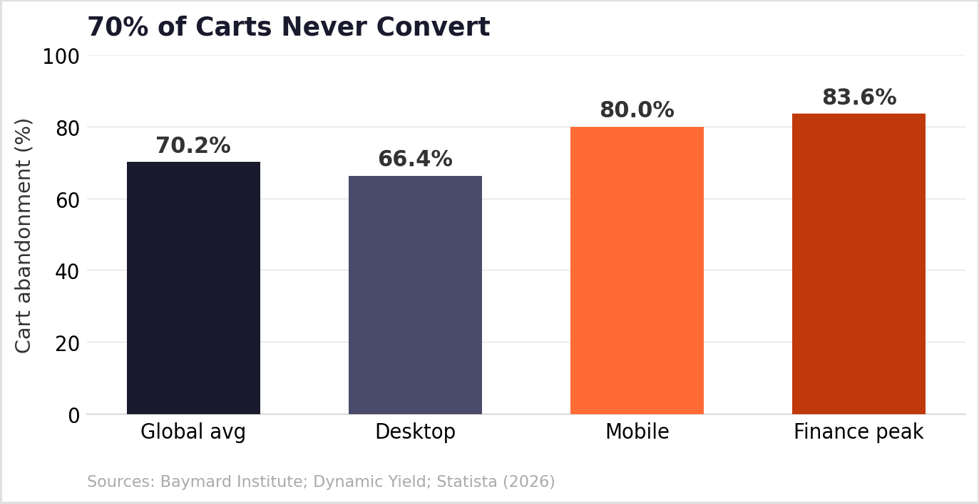
Figure 1: Cart abandonment has hovered near 70% for a decade — and mobile, now the majority of traffic, is worse.
Now layer on what today's customer expects. 91% of consumers say they prefer brands that personalize, and AI-driven personalization has been shown to lift conversions by up to 202%.[1 5] Yet 84% of brands still fail to differentiate through personalization.[3] The gap between what customers want and what brands deliver has never been wider — and that gap is where revenue is won or lost.
Acquisition gets you a customer once. Engagement is what turns that one purchase into ten. In 2026, the brands that win aren't the ones shouting loudest — they're the ones remembering best.
Why This Is the Topic of 2026
Three tectonic shifts are colliding at once, and together they make customer engagement the single most important growth lever a business has this year.
1. The cookie is dying — and first-party data is king
Roughly 48% of global web traffic is already cookieless, and brands that build strategies on first-party data — the data customers give you directly — see up to 2.9× revenue uplift.[15] The implication is stark: the customer data locked inside your own systems is now your most valuable marketing asset. The question is whether you can activate it.
2. AI turned personalization from a luxury into a default
The AI-marketing market hit $47 billion in 2025 and is projected to exceed $107 billion by 2028.[14] AI is no longer a differentiator you brag about; it is the baseline customers assume. Notably, 64% of shoppers now say AI has improved their retail experience, up from 51% in 2023.[16]
3. Loyalty is fragile — and fickle
SAP's Customer Loyalty Index — surveying 12,041 consumers across five markets — found that True Loyalty (deep, emotional attachment) fell 5% in a single year, its first decline in five years. A new, hype-driven “Trend Loyalty” now describes 14% of consumers.[12]

Figure 2: Loyalty is shifting from durable attachment toward fleeting, trend-driven behavior — making every retained customer more valuable.
THE CONVERGENCE
Three shifts, one answer
Cookieless data + AI-default personalization + fragile loyalty all point to the same conclusion: businesses must activate their own first-party data to deliver AI-personalized experiences that earn loyalty in real time. That is the exact job an engagement platform does — and it is why this category, not another ad channel, is where smart budget is moving in 2026.
What SAP Engagement Cloud Is — And How It Works
On 17 February 2026, SAP rebranded Emarsys as SAP Engagement Cloud, positioning it as the engagement core of Intelligent CX from SAP.[1] The existing product continues as the “Emarsys Edition,” joined by a new “Enterprise Edition” for multi-brand, multi-region organizations.[1] It has been named a Leader in the Gartner Magic Quadrant for Personalization Engines for seven consecutive years.[4]
At its heart, it is an AI-powered omnichannel engagement platform. It unifies your customer, sales, and product data into a single customer view; uses AI to decide who to talk to, what to say, and when; and orchestrates that message across email, SMS, web, mobile app, push, digital ads, mobile wallet, and conversational channels like WhatsApp and LINE. Then it measures the revenue and feeds the result back into the next decision.
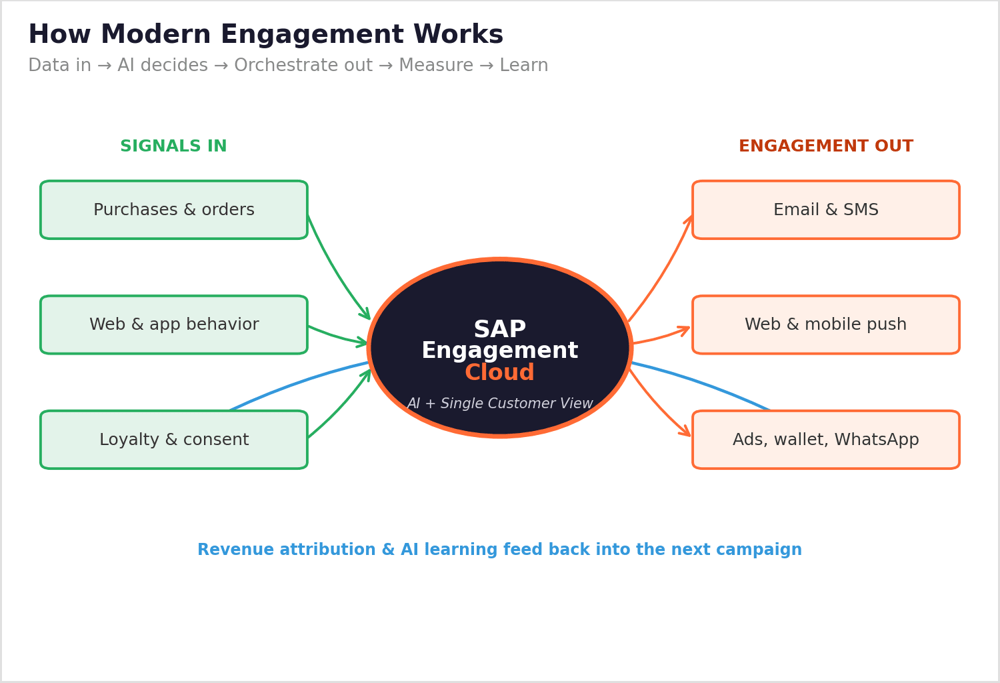
Figure 3: The engagement loop — signals flow in, AI decides, messages orchestrate out across channels, and revenue attribution feeds the next cycle.
The Features That Do the Work (And How to Use Them)
This is where most overviews stop at buzzwords. Let's go deeper. SAP Engagement Cloud has embedded AI for over a decade — Smart Insight (RFM) shipped in 2013, the Predict recommendation engine in 2014 — long before the current wave of hype.[16] Here are the capabilities that matter, and exactly how a team puts each to work.
Smart Insight — know who is actually valuable
Smart Insight is the analytics brain. It applies RFM modeling (Recency, Frequency, Monetary value) to automatically sort your entire base into lifecycle segments — first-timers, active, defecting, lapsed, high-value — and predicts customer lifetime value.[17] How to use it: stop blasting the same email to everyone. Increase send frequency to your most engaged, high-value segments and dial it back for the disengaged. PUMA did exactly this and grew engagement while reducing fatigue.[9]
Predict — 1:1 product recommendations that convert
The Predict engine serves personalized product recommendations across email, web, and mobile, driven by each individual's browsing and purchase history.[17] How to use it: place “Recommended for you” blocks on your homepage for returning visitors, “frequently bought with” on product pages, and “you may also like” in cart and post-purchase emails. Every impression is unique to the shopper — no manual merchandising required.
AI Segments — audiences that build themselves
Instead of writing rules, marketers generate AI Segments based on predicted behaviors: likelihood to purchase, likelihood to churn, predicted spend, and channel engagement.[20] How to use it: target “high churn risk, high value” with a win-back offer, or “high purchase intent in the next 2–3 months” with your best content — as PUMA did to focus effort where it pays.[9]
Send Time Optimization — the right moment, per person
STO uses machine learning to send each contact their email at the time they are individually most likely to open, and it continuously adapts as behavior changes.[17] How to use it: switch it on. It requires no extra work and, in PUMA's case, lifted open rates a further 5–10%.[9]
Generative AI — content at the speed of send
Built-in generative AI writes subject lines, preheader text, and personalized product offers, with tools like Subject Line Generator and Product Finder.[19] How to use it: draft ten subject-line variants in seconds, A/B test them, and keep the winner — cutting production time without sacrificing quality.
Native Loyalty — reward without a second platform
A loyalty solution is built directly into the platform, so points, tiers, and rewards live inside the same customer communications — no bolt-on required.[2] How to use it: trigger a tier-upgrade celebration with a first-purchase benefit, or nudge members when points are about to expire.
Inside the Pre-Built Tactics: 100+ Campaigns, Ready to Launch
The single most underrated feature is the Tactics library. These are 100+ pre-built, fully customizable automation programs — complete workflows (entry triggers, decision splits, wait times, messages) crowdsourced from the world's most innovative brands and mapped to real business goals.[6] Instead of building an automation from a blank canvas over weeks, a marketer activates a proven one in an afternoon. Here is what actually lives in the library, organized by lifecycle stage:
| Lifecycle stage |
Example tactics | What it does for you |
| Acquisition | Welcome series, first-purchase nurture, lead re-engagement, referral | Turn anonymous → known → first purchase |
| Conversion | Abandoned cart, browse abandonment, category-affinity follow-up | Recover intent before it cools |
| Post-purchase | Order & shipping confirmation, review request, cross-sell | Build trust, lift AOV and repeat rate |
| Retention | Replenishment reminder, win-back, defecting-customer save | Catch customers before they lapse |
| Loyalty | Join-the-program, tier upgrade, points-expiry reminder | Reward and deepen engagement |
| Alerts | Back-in-stock, wishlist price-drop, inventory alerts | High-conversion, low-effort triggers |
Table 1: A sample of the 100+ crowdsourced tactics. Each is customizable and deployable across channels in a fraction of custom-build time.
HOW TO USE THEM
The 90-day tactics rollout that de-risks everything
Don't boil the ocean. The proven sequence: (1) start with your highest-ROI “business-as-usual” tactic — usually welcome or abandoned cart; (2) validate the data flow and personalization; (3) expand into low-risk tactics like browse abandonment and lead re-engagement; (4) layer channels one at a time — email first, then SMS, push, and wallet. This phased approach builds team confidence while recovering revenue from week one.
The Proof: Real Brands, Real Numbers
Features are promises. Outcomes are proof. These results were reported by SAP and its customers — directional by nature, but they show what disciplined engagement produces at scale.
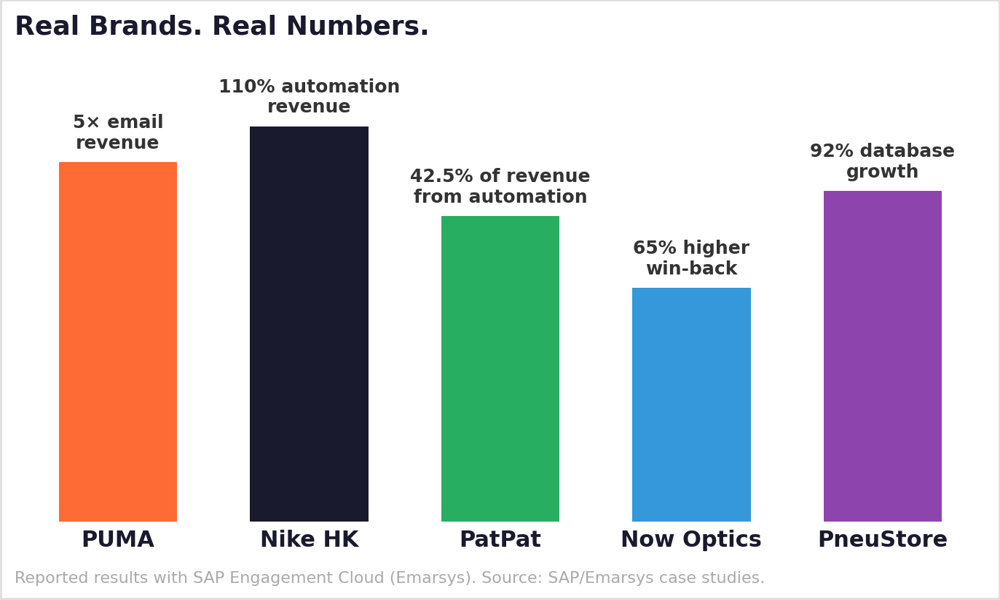
Figure 4: Headline outcomes reported across five SAP Engagement Cloud customers.
- PUMA — 5× increase in email revenue, 25% lift in open rates, and 50% database growth in six months, using Smart Insight, STO, and 11 automated journeys including Back-in-Stock and replenishment.[8]
- Nike Hong Kong — 110% increase in automation revenue, 32.5% rise in website visits, +8% purchase rate and +28% average order value across 10 AI-driven lifecycle programs.[11]
- PatPat — doubled revenue, with 42.5% of revenue from automation and AOV up 33%; email deliverability improved from 60% to over 99% across 183 automated programs.[11]
- Now Optics — a no-show reactivation journey lifted win-back rates 65% year-over-year; prescription reminders generated 7.6 million engagements in a year.[11]
- BSTN — sent 172,000 personalized WhatsApp messages in 90 days to combat churn, cutting paid-ad reliance by focusing on high-performing channels.[11]
Zooming out from individual brands: an independent IDC Business Value study found interviewed organizations achieved $4.7 million per year in benefits with 35% more productive marketing teams, and cut campaign build time from one week to a single day.[13]
For SAP Commerce Cloud Customers: An Unfair Advantage
Everything above applies to any business. But if you run SAP Commerce Cloud, you have a shortcut. SAP Engagement Cloud connects to it through a native, plug-and-play integration — not a bespoke middleware project. Once connected, it synchronizes customers, orders, events, product catalogs, and consent in near real time, and reacts to commerce events the moment they happen.[2]
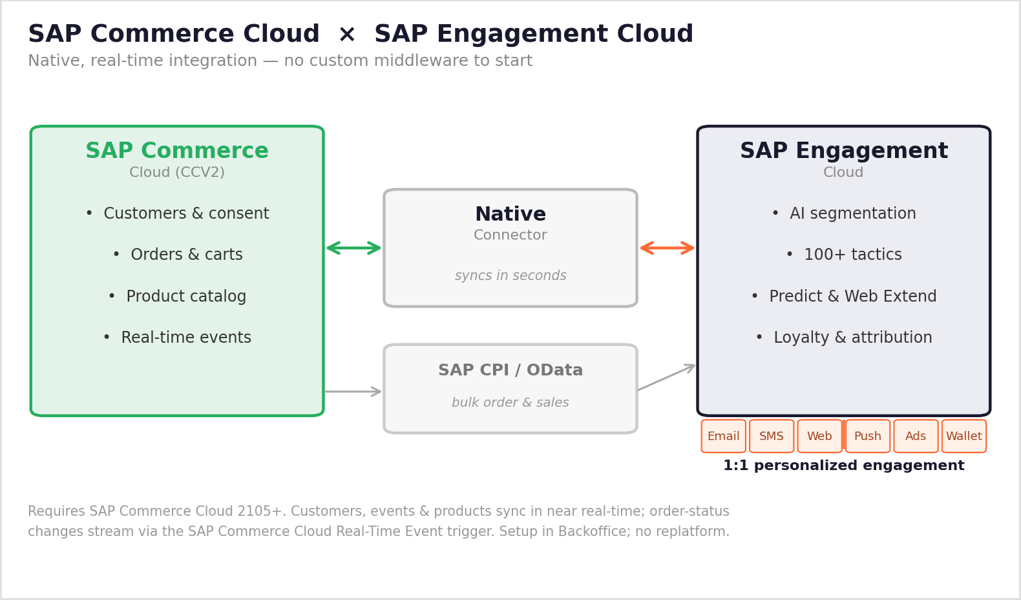
Figure 5: The native integration keeps SAP Commerce Cloud as the system of record while SAP Engagement Cloud activates that data across every channel.
The SAP Commerce Cloud Real-Time Event trigger streams the full event payload — an order status change, a price change, a cart update — into journeys as it happens.[6] For higher-volume order and sales exports, SAP Cloud Integration (CPI) with the OData EmarsysOrder API handles the bulk flow. Setup is done in Backoffice with an admin user; there is no replatform required.[8]
TECHNICAL PREREQUISITE
This is a modern-platform capability
The native integration requires SAP Commerce Cloud 2105 or newer and is not backwards-compatible with older releases.[6] For estates still on legacy versions — or on the Accelerator storefront heading toward its 2028 end-of-life — this is one more reason the platform upgrade and the engagement strategy belong on the same roadmap.
TECHNICAL PREREQUISITE
This is a modern-platform capability
The native integration requires SAP Commerce Cloud 2105 or newer and is not backwards-compatible with older releases.[6] For estates still on legacy versions — or on the Accelerator storefront heading toward its 2028 end-of-life — this is one more reason the platform upgrade and the engagement strategy belong on the same roadmap.
The Akkodis Approach: From Connected to Compounding
Switching the platform on is easy. Making engagement compound — where every campaign feeds the next and engagement becomes a durable capability — is where an experienced partner earns its place. Akkodis brings deep SAP engineering together with customer-engagement strategy so the platform and the operating model advance together.
Phase 1 — Data & Foundation (1–3 weeks)
Validate your platform version and integration prerequisites, map customer, order, and product data plus consent, and stand up the real-time event flow. A clean, governed foundation before a single campaign is designed.
Phase 2 — Quick-Win Tactics (2–4 weeks)
Deploy the highest-ROI pre-built tactics first — welcome, abandoned cart, post-purchase — to prove the data flow and start recovering revenue immediately.
Phase 3 — AI & Orchestration (4–8 weeks)
Build AI Segments, Predict-powered recommendations, and cross-channel journeys, expanding from email into SMS, web, push, and wallet in a controlled sequence.
Phase 4 — Optimize & Scale (ongoing)
Instrument A/B testing, revenue attribution, RFM-based win-back, and native loyalty. Engagement becomes a compounding asset, not a cost center.
Your Engagement Readiness Checklist
Before you activate, your team should be able to answer these:
- Do we have clean, unified customer data with distinct email addresses, so it syncs without creating duplicates?
- Do we have a documented consent model, so opt-ins and opt-outs synchronize compliantly?
- Which three tactics (e.g. welcome, abandoned cart, browse) would we launch first for fastest ROI?
- Do we have a channel-sequencing plan — email first, then SMS, push, wallet — rather than a big-bang launch?
- If we're on SAP Commerce Cloud, are we on 2105+ so the native integration is available?
- Who owns the engagement operating model after go-live: campaign design, testing, and optimization?
If any of these expose uncertainty, that is exactly where a focused Akkodis discovery workshop converts ambiguity into a costed, sequenced plan.
The Bottom Line
Your systems already hold the signals that predict your next sale: the abandoned cart, the browsed-but-not-bought product, the customer who hasn't returned in ninety days. SAP Engagement Cloud is the engine that acts on those signals — automatically, across every channel, in real time. In a world where the cookie is dying, AI is the default, and loyalty is fragile, that isn't an incremental improvement. It's the difference between a business that sells once and a business that keeps its customers for life.
Every abandoned cart is a customer your competitor assumes is theirs. Engagement is how you prove them wrong — one perfectly-timed, deeply-personal message at a time.
Your Customers. Re-engaged. For Life.
Akkodis SAP Practice helps you activate SAP Engagement Cloud — and connect it to your SAP Commerce Cloud stack — safely, quickly, and built to compound. Start with a free engagement discovery workshop.
SOURCES & REFERENCES
Every numbered claim in this article maps to a source below. Figures were current as of publication; verify against the linked sources for the latest data.
[1] Emarsys → SAP Engagement Cloud rebrand; Emarsys Edition + Enterprise Edition; 2026 roadmap. emarsys.com/learn/blog/from-sap-emarsys-to-sap-engagement-cloud-powering-the-next-era-of-engagement/
[2] SAP Engagement Cloud + SAP: native SAP Commerce Cloud integration (order confirmation, cart abandonment, post-purchase); native loyalty. emarsys.com/emarsys-sap/
[3] “Transform Your SAP Commerce Stack into a Retail Personalization Powerhouse” — 84% of brands fail to differentiate; 8 tactics. emarsys.com/learn/blog/how-to-transform-your-sap-commerce-stack-into-a-retail-personalization-powerhouse/
[4] SAP a Leader in 2026 Gartner Magic Quadrant for Personalization Engines (7th consecutive year); PUMA, Mizuno, John Frieda outcomes. news.sap.com/2026/02/sap-a-leader-2026-gartner-magic-quadrant-personalization-engines/
[5] SAP Engagement Cloud Strategies & Tactics: 100+ pre-built, crowdsourced automation programs; lifecycle stages. emarsys.com/strategies-tactics/
[6] Native SAP Commerce Cloud integration — requires 2105+; real-time customer/event/product sync; Real-Time Event trigger; setup steps. royalcyber.com/blogs/sap-commerce/how-to-market-omnichannel-with-sap/
[7] SAP Commerce Cloud Real-Time Event trigger — full event payload streamed to journeys. help.emarsys.com/hc/en-us/articles/15059175403537-Triggers-SAP-Commerce-Cloud-Real-Time-Event
[8] SAP Commerce Cloud order integration via SAP CPI + OData EmarsysOrder API; setup in Backoffice. blogs.sap.com/2023/08/02/sap-commerce-cloud-sales-order-integration-with-sap-emarsys-customer-engagement-using-sap-cloud-platform-integration/
[9] PUMA case study: 5× email revenue, 25% open-rate lift, 50% database growth; Smart Insight; STO +5–10%. emarsys.com/learn/blog/improving-email-engagement-rates/
[10] Cart abandonment 70.22% (2026); mobile 80.02%; $260B recoverable (Baymard / Dynamic Yield / Statista). baymard.com/lists/cart-abandonment-rate
[11] 9 real-world omnichannel campaign results (Nike HK, PatPat, Now Optics, BSTN, etc.) with metrics. www.cuspera.com/products/sap-emarsys-customer-engagement-x-1396/customer-story
[12] SAP Customer Loyalty Index 2025: True Loyalty −5%; Trend Loyalty 14%; 12,041 respondents across 5 markets. emarsys.com/learn/white-papers/customer-loyalty-index-2025-global/
[13] IDC Business Value study: $4.7M/yr benefits; 35% more productive teams; 1 week → 1 day campaign build. emarsys.com/learn/white-papers/the-business-value-of-sap-emarsys-customer-engagement/
[14] AI-marketing market $47B (2025) → $107B (2028); cookieless 48%; first-party 2.9× uplift; AI personalization +202%. www.averi.ai/blog/ai-marketing-trends-in-2026-what-to-expect-and-how-to-stay-ahead
[15] 91% of consumers prefer personalization; 202% conversion lift; 96% of retailers struggle with personalization. www.demandsage.com/personalization-statistics/
[16] SAP Engagement Cloud AI heritage: Smart Insight/RFM (2013), Predict engine (2014); 64% say AI improved retail experience. emarsys.com/learn/blog/demystifying-ai/
[17] Emarsys AI Marketing: Send Time Optimization, Predict, Smart Insight, Incentive Recommendation explained. www.emarsys.com/en-uk/products2/artificial-intelligence-marketing/
[18] 100+ prebuilt e-commerce tactics; abandoned cart, browse abandonment, back-in-stock, price-drop, replenishment. emarsys.com/industry-solutions/ecommerce/
[19] Generative AI features: Subject Line Generator, Preheader Generator, Product Finder, Segment Generator. emarsys.com/learn/blog/emarsys-june-2024-product-release-ai-announcements-omnichannel-innovations-and-more/
[20] AI Segments based on predicted lifecycle, spend, and channel engagement; first-party data activation across channels. emarsys.com/product-hub/