How AI-Powered Digital Twins Are Transforming Risk Prediction From Operating Rooms to Aircraft Cockpits
Can a Digital Twin Help Prevent Critical Incidents Before They Happen?
5 minutes
9th of April, 2026
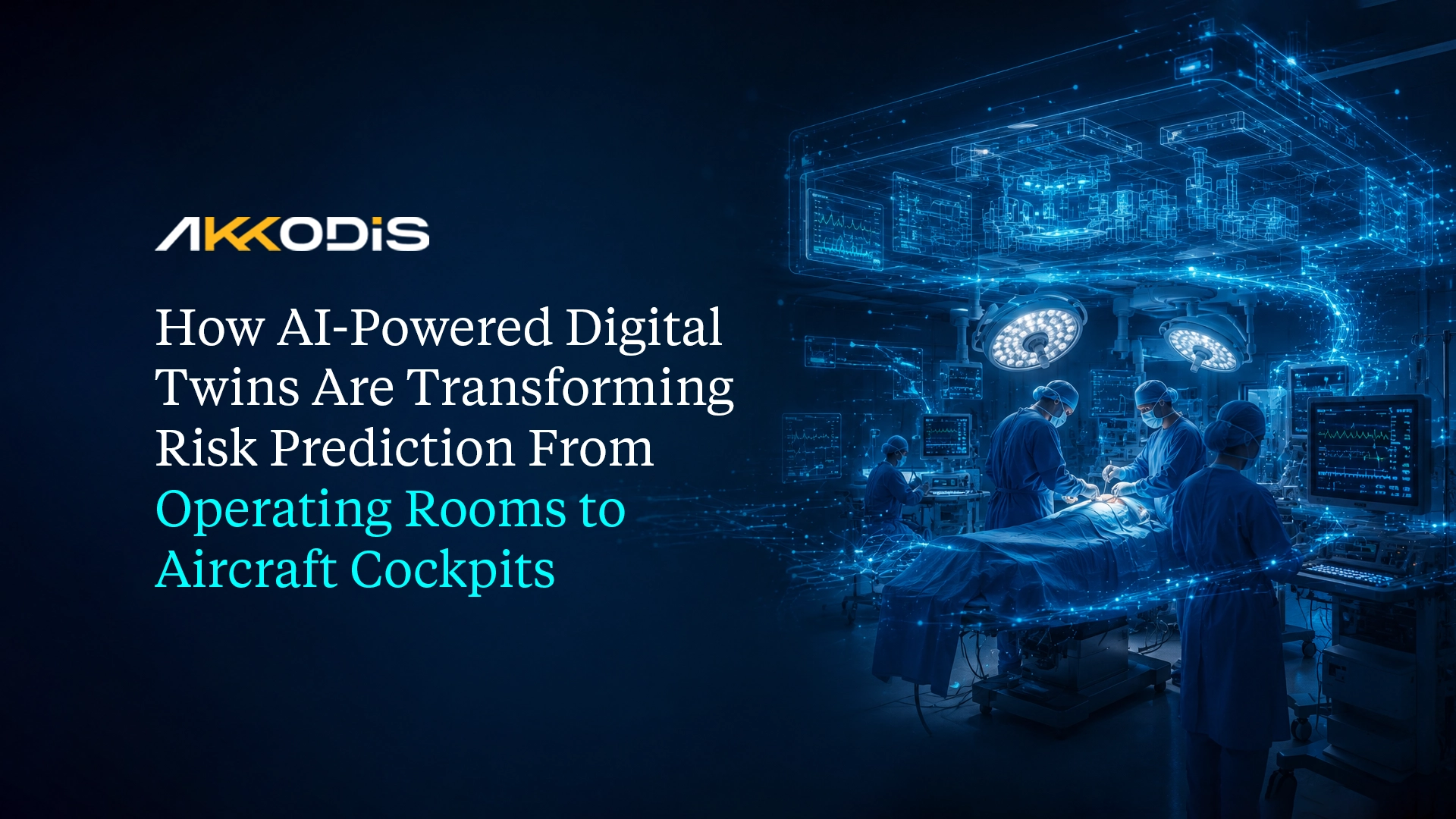
Even in the highly controlled environment of an operating room, where experienced surgeons follow rigorous protocols, unexpected events can still occur. Equipment failures, physiological complications, or communication breakdowns can have serious consequences for patients and healthcare providers alike.
According to France's National Authority for Health (HAS), thousands of serious adverse events continue to be reported in healthcare settings each year, highlighting the ongoing need for smarter approaches to risk prevention.
As populations age and medical procedures become increasingly complex, healthcare systems face growing pressure to improve patient outcomes while maintaining efficiency. This raises an important question:
What if healthcare teams could anticipate critical events before they happen?
That is the challenge addressed by PRIA (Prédiction des Risques par Intelligence Artificielle), an innovative Akkodis-led project that combines artificial intelligence, predictive analytics, and digital twin technology to help medical teams identify risks in real time.

The aim is to move beyond reactive alerting and toward proactive risk anticipation. By synchronizing a digital twin with the real environment, we can model, predict, and anticipate potential risks before they occur.
Imen Abidi, PRIA Project Leader
Bringing Predictive Intelligence Into the Operating Room
The healthcare sector is experiencing rapid technological transformation. While innovations are enabling more sophisticated treatments and surgical procedures, they are also introducing new levels of operational complexity.
To address this challenge, the PRIA team developed a digital twin of an operating room: a virtual representation continuously synchronized with its physical counterpart.
Using AI models and predictive analytics, the system can monitor multiple variables simultaneously and detect patterns associated with potential adverse events, including:
- Equipment malfunctions
- Abnormal patient vital signs
- Elevated infection risks
- Cognitive overload among medical teams
- Critical care escalation scenarios
Rather than simply reacting to incidents, the system helps clinicians anticipate them, enabling faster and more informed decision-making.
A Digital Twin That Learns and Adapts
At the heart of PRIA is a sophisticated digital twin architecture designed to capture the complexity of a real operating room.
The project team, which included between 10 and 20 specialists throughout its development, adopted a multi-agent system approach. Different intelligent agents are responsible for monitoring, prediction, adaptation, and decision support, enabling the platform to respond dynamically as conditions evolve.
"The core idea is the digital twin itself," explains Abidi. "We have a physical operating room and a digital counterpart. The two systems synchronize regularly, allowing the digital environment to perform modeling, simulation, learning, and anticipation."
This continuous exchange between the physical and digital worlds creates a powerful feedback loop that supports both operational performance and future system learning.
The platform also incorporates reinforcement learning, enabling the digital twin to improve predictions over time as it analyzes additional scenarios and outcomes.
Overcoming Challenges to Advance Patient Safety
Developing predictive AI for healthcare was not without obstacles.
One of the project's biggest challenges involved access to clinical data. To overcome this limitation while ensuring compliance with privacy requirements, the research team relied on synthetic data to train and validate models.
Despite these constraints, the team deliberately chose healthcare as its initial focus because of the technology's potential societal impact.
"If a system can proactively anticipate risks and help medical teams prevent adverse events, it can contribute directly to saving lives," says Abidi.
The next stage of development could involve testing the platform within real-world operating room environments to further validate its predictive capabilities under live conditions.
Beyond Training: A New Model for Risk Management
Digital twins are often associated with simulation and training.
PRIA goes significantly further.
By combining real-time operational data with predictive AI, the platform creates an environment where healthcare professionals can assess potential future scenarios before they materialize.
This shift from reactive monitoring to proactive risk management represents a major step forward for healthcare innovation.
The result is a system capable of:
- Anticipating emerging risks
- Supporting clinical decision-making
- Improving patient outcomes
- Enhancing operational efficiency
- Strengthening overall system resilience
From Hospital Operating Rooms to Aircraft Cockpits
While developed initially for healthcare, the technology behind PRIA has applications far beyond medicine.
"The key innovation is the digital twin concept itself," says Abidi. "It can be applied to any complex, non-deterministic system involving multiple interacting entities."
One such environment is aviation.
Aircraft cockpits share many characteristics with operating rooms: high levels of complexity, substantial cognitive demands, and an absolute commitment to safety.
The PRIA team has already begun applying its expertise to aviation use cases.
Working alongside a major aircraft manufacturer, researchers analyzed data from:
- Flight management systems
- Aircraft engines
- Electroencephalogram (EEG) monitoring
- Electrocardiogram (ECG) measurements
- Eye-tracking systems
- Respiration sensors
The objective was to better understand pilot cognitive workload, fatigue, and decision-making under operational conditions.
Supporting the Future of Single Pilot Operations
One particularly relevant application lies in the ongoing discussion around Single Pilot Operations (SPO).
As the aerospace industry explores potential SPO models, safety remains the foremost consideration.
Predictive digital twin technology could provide valuable support by helping detect emerging risks, monitoring pilot cognitive states, and delivering real-time decision assistance.
"In an SPO environment, the pilot has significant responsibilities," says Abidi. "A predictive support system that can anticipate risks and assist decision-making could improve both safety and operational efficiency."
While the aviation industry continues to evaluate future operating models cautiously, AI-powered digital twins could play an important role in ensuring any transition maintains the highest safety standards.
The Future of AI-Powered Digital Twins
The PRIA project demonstrates how digital twins are evolving beyond simulation tools into intelligent systems capable of predicting, learning, and supporting critical decisions in real time.
Whether in healthcare, aerospace, manufacturing, energy, or smart infrastructure, organizations increasingly need technologies that can transform uncertainty into actionable insight.
"The main strength of digital twins is their ability to maintain synchronization between the digital and physical worlds," concludes Abidi. "Even when uncertainties or errors occur, the system can adapt and update quickly."
From operating rooms to aircraft cockpits, AI-powered digital twins are helping organizations anticipate what comes next, enhancing safety, resilience, and performance along the way.
For digital twins, the sky is no longer the limit. It's just the beginning.
