From Play to Prevention: Combining Serious Games and AI for Early Health Warnings
Discover how AI-powered serious games are transforming early detection of cognitive frailty and supporting healthcare professionals with faster, more precise insights.
5 minutes
1st of April, 2026
Early detection is crucial in reducing the impact of many age-related chronic illnesses, and games can serve as a valuable tool for identifying early signs of cognitive frailty in older adults. Akkodis AI expert Asma Gasmi is integrating these games into an AI model, enabling doctors to intervene earlier and more effectively than before.
Serious Games for Cognitive Assessment in Healthcare
A fish-catching game projects virtual fish across a surface in front of the player, creating an interactive environment for cognitive testing. When a red fish appears, the player must tap it to score points, while avoiding yellow fish to prevent negative scoring.
This type of serious game provides valuable insights into a person’s hand-eye coordination, reaction time, and cognitive function. Serious games are designed for purposes beyond entertainment, including cognitive assessment, education, and professional training.

This type of serious game provides valuable insights into a person’s hand-eye coordination, reaction time, and cognitive function
In healthcare, serious games are increasingly used for surgical simulations, ADHD treatment, and cognitive assessment. In elderly care, they offer a more engaging and scalable alternative to traditional tests and questionnaires. Games like the fish-catching example enable doctors and nursing staff to assess cognitive frailty more effectively and identify early signs of decline.
AI-Powered Serious Games for Early Detection in Healthcare
By integrating Artificial Intelligence, serious games are evolving into powerful tools for early detection and proactive healthcare monitoring. AI-driven serious games have the potential to transform early warning systems by enabling faster and more accurate identification of cognitive decline.
AI can scale the use of serious games for early detection by automating the analysis of gameplay through video recordings and sensor data. Instead of waiting days or weeks for manual review, AI models deliver real-time insights, allowing healthcare professionals to quickly identify high-risk cases and take timely action.
AI-powered serious games overcome the limitations of traditional, resource-intensive neuropsychological tests by enabling continuous and repeatable cognitive assessment. This allows for more precise tracking of cognitive decline over time, providing deeper insights and improving early intervention strategies.
The Importance of Early Detection in AI-Driven Healthcare
These advantages are critical for advancing AI-driven healthcare, particularly in improving elderly care. Speed, efficiency, and real-time analysis enable the wider adoption of serious games for early detection of age-related conditions. Diseases such as Alzheimer's disease and Multiple Sclerosis highlight the importance of early diagnosis, as earlier detection gives doctors and caregivers greater opportunities to slow progression, reduce impact, and improve patient outcomes—even in cases where a cure is not yet available.
Asma Gasmi, Tech Lead in AI and Machine Learning at Akkodis, is advancing this field by exploring AI-powered serious games analysis as part of an innovative research project called STAYWELL.
STAYWELL (Sustainable Technology to Analyze Wellness Among Chronically Ill Patients) focuses on developing wearable healthcare technology for patients with chronic conditions. These devices use sensors to collect real-time health data, integrate it with patient medical history, and provide actionable insights to doctors and caregivers, enabling more proactive and personalized care.
Building AI Models for Multimodal Healthcare Data
By integrating serious games analysis, Gasmi is adding a new dimension to the STAYWELL project, enhancing the assessment of cognitive frailty. This approach addresses key limitations of traditional methods, including limited personalization, low adaptability, and simplified evaluation metrics, enabling more precise and scalable cognitive assessment.
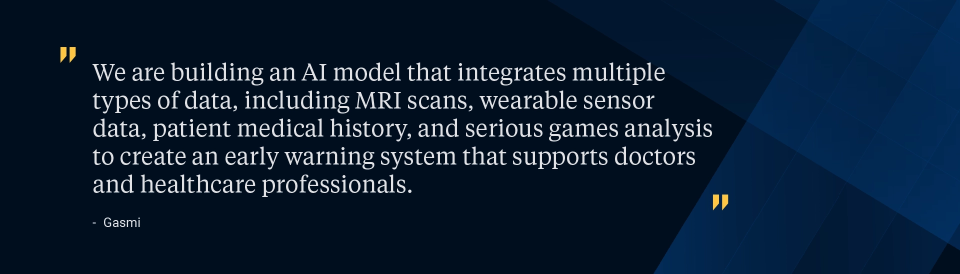
who is currently looking for partners for the project— companies in the healthcare sector as well as nursing homes and research facilities, interested in testing the technology.
Gasmi is currently seeking partners for the project, including healthcare organizations, nursing homes, and research institutions interested in testing and advancing AI-powered healthcare solutions.
As part of the initiative, the team is automating the analysis of MRI scans to detect early signs of Multiple Sclerosis. Research shows that early diagnosis can significantly slow disease progression, reduce the risk of severe disability, and improve long-term patient outcomes.
To achieve these results, the AI model must be carefully trained and optimized to extract meaningful insights from diverse, multimodal data sources. Ensuring high accuracy, reliability, and clinical relevance is essential for delivering effective AI-driven early detection systems.
AI in Healthcare: Supporting Doctors, Not Replacing Them
Gasmi emphasizes that AI-powered healthcare solutions, such as the STAYWELL AI model, are designed to support doctors in clinical decision-making rather than replace them. These technologies enhance human expertise by providing actionable insights and improving the accuracy of medical assessments.
AI-driven tools enable healthcare professionals to access larger volumes of patient data with greater efficiency. By reducing resource-intensive testing and enabling more frequent assessments, these solutions support continuous patient monitoring and help detect early deviations from individual health baselines.
Gasmi envisions a future where AI-enabled healthcare systems continuously monitor patient health, particularly in elderly care environments, helping individuals maintain their well-being and independence for longer.
She highlights that this represents one of the most impactful applications of AI in healthcare—supporting medical professionals while improving quality of life and care outcomes for aging populations.