As Long-Range Drones Scale Up, Production and Integration Demand Follows
Learn how long-range drones are changing aerospace and defense through persistent surveillance, autonomous inspection, advanced sensing, and multi-domain operations.
5 minutes
17th of September, 2026
For years, many drone missions followed a set sequence of events. A platform launched, collected imagery or sensor data, returned to base, and handed the information to people for review. That model still has a place, but new capabilities are widening how drones are being used.
Long-range drones can stay airborne for much longer, work from smaller launch areas, carry interchangeable sensors, and process more information while a mission is underway. As those capabilities combine, drones are moving into jobs that once depended on crewed aircraft, ships, ground vehicles, or fixed surveillance infrastructure.
For aerospace and defense leaders, the change is operational. Surveillance drones can maintain coverage for hours, autonomous drones can work with other platforms, and inspection systems can collect detailed aircraft data quickly enough to change how maintenance work is planned.
Long-Range Drones Are Expanding Operational Possibilities
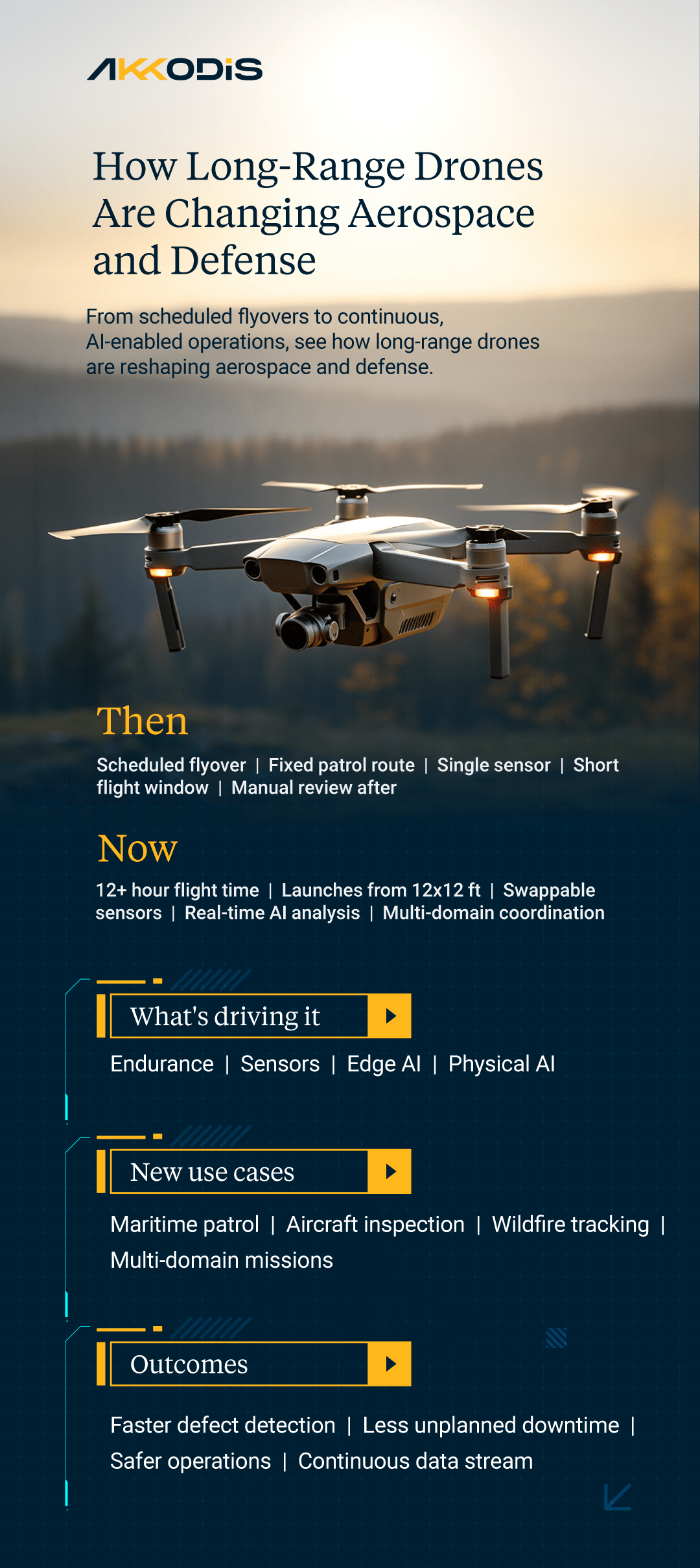
Endurance changes what a drone can realistically be used for. A short flight captures a snapshot, while a mission lasting half a day can follow a changing situation, revisit areas of interest, and keep sensors in place with fewer launch and recovery cycles.
The Airbus U030 Flexrotor provides a useful example of this. The Group 2 VTOL aircraft has a maximum takeoff weight of 25 kg, typical endurance of 12 to 15 hours, and can take off and land within a 3.7 by 3.7 meter area, roughly 12 by 12 feet.
Those characteristics are already supporting real operations. In July 2026, the platform began maritime surveillance missions in the Baltic region for the European Maritime Safety Agency, carrying electro-optical, infrared, and radar payloads while streaming intelligence in real time.
Long-range drones with compact launch footprints can place persistent sensing closer to the mission, reducing reliance on runways, larger support footprints, and repeated patrol cycles.
New Drone Missions Extend Beyond Traditional Tasks
As endurance, autonomy, and sensors improve together, drones are taking on work that changes how operations are organized.
Aircraft inspection is one example. NASA has supported development of an autonomous drone system for commercial aircraft inspection that can collect inspection data around an airliner in less than 30 minutes. Traditional pre-flight inspections can take much longer and may require personnel to work at height around the aircraft.
Persistent aerial coverage can also support situations that change over several hours. NASA’s wildfire research, for example, is developing remotely piloted aircraft capabilities that could help teams monitor and respond to forest fires around the clock.
Defense missions are also showing how much more powerful drones become when different platforms work together. Akkodis has helped develop a multi-domain mine-hunting system that combines aerial, surface, and underwater drones, using AI-powered decision-making to coordinate each platform as part of one connected mission. This gives an idea of where autonomous systems are heading, with multiple assets sharing information and responding together rather than operating in isolation.
Autonomous Drones Depend on Better Sensors and Faster Decisions
Greater endurance becomes much more valuable when it’s paired with better sensing, onboard processing, and autonomy. These capabilities are advancing together:
- More capable sensor packages allow platforms to support surveillance, thermal imaging, radar, mapping, and other mission needs.
- Longer endurance keeps those sensors in the field for extended periods and reduces the number of launches needed to maintain coverage.
- AI can process imagery and sensor data during the mission, helping operators identify relevant events sooner instead of reviewing every frame after landing.
As fleets grow, the volume of information grows with them. Connected defense environments already depend on near-real-time information sharing across platforms, while military networks increasingly link sensors, communications, command systems, and autonomous assets.
Engineering challenges also come into play, as communications, sensor fusion, autonomy, cybersecurity, and human oversight all have to perform together in demanding operational conditions.
Military Drones Are Becoming Part of Larger Mission Systems
Military drones increasingly operate as nodes within wider systems, where their value depends partly on how effectively platforms can share information and coordinate their roles.
The mine-hunting initiative that Akkodis teams are supporting makes the principle tangible. Airborne systems can map an area, surface platforms can move sensors closer to suspected hazards, and underwater vehicles can investigate objects other platforms can’t reach. Coordinated decision-making allows the mission to progress across domains while keeping information connected.
The same systems thinking appears across modern defense engineering, where interoperability matters more as the number of intelligent assets increases. For aerospace and defense organizations, autonomous capability creates integration work alongside platform development, including mission software, secure communications, system-level safety, verification, and validation.
Long-Range Drones Increase Production and Integration Demand
Long-endurance surveillance is entering operational service, autonomous aircraft inspection is moving into commercial environments, and defense programs are developing more connected combinations of crewed and uncrewed systems.
That momentum is generating significant demand across the industry. Organizations need to industrialize airframes and payloads, integrate sensors and software, validate autonomous behavior, secure communications, and test complete systems under realistic conditions.
Related work in aerospace robotics and AI shows how intelligent automation is moving into real operational environments, while end-to-end aerospace testing becomes more important as autonomous systems grow more interconnected.
The wider significance of long-range drones comes from the missions they support. Persistent sensing, faster inspection, and multi-domain coordination can replace operating models built around periodic visits, fixed infrastructure, and separate platforms. As these systems become more capable, aerospace and defense organizations will need to turn individual technologies into reliable, integrated mission capabilities.
Turning Drone Capability Into Operational Advantage
Aerospace and defense organizations are entering a phase where endurance, autonomous decision-making, advanced sensing, and multi-domain coordination have to come together as engineered systems.
We support this transition across systems engineering, autonomous systems, software development, validation, connected intelligence, and industrialization.
Explore our Aerospace and Defense capabilities or reach out to our team to learn how we help grow and improve programs across aeronautics, space, and defense.
About the Author
Shreyans Shrimal leads the Aerospace practice for Akkodis North America, working directly with clients across aerospace, defense, and mobility to turn complex engineering challenges into practical, scalable solutions. His perspective in this series is shaped by close attention to the new technologies and emerging disruptors reshaping the industry, and to how established aerospace companies can close the execution gap to keep pace.